
Rethinking Job Design in a Constrained Labor Market
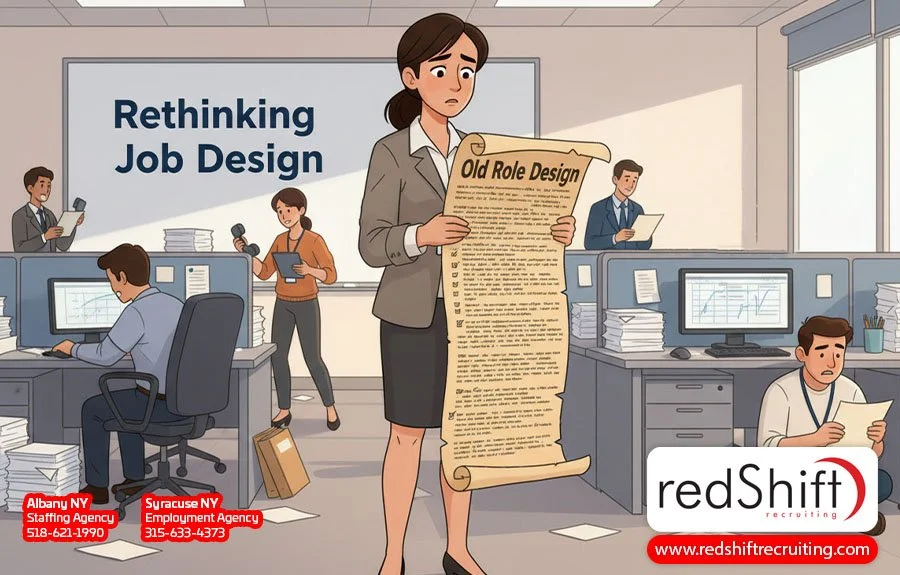
A job description is easy to overlook as a source of operational problems. It's background infrastructure—written once, updated rarely, and largely taken for granted. Instead, most conversations about workforce challenges focus on supply: not enough workers, not enough experienced candidates, not enough people willing to do the work. But when open roles stay open, teams stay strained, and the same gaps keep reappearing, there may be a more fundamental problem with the job design itself.
Many roles were built around assumptions that no longer hold: stable headcount, predictable turnover, time and capacity for training. As those conditions have changed, the structure of the work often hasn't, creating bottlenecks that recruiting alone can't fix. Rethinking job design means examining not just who is available to hire, but whether the work is organized in a way that the available workforce can actually sustain.
Traditional Job Design Assumed a Stable Workforce
For most of modern workforce history, job design followed a fairly consistent logic. Roles were built around clearly defined responsibilities, supported by predictable staffing levels and enough time for training and development. The assumption was that teams would have the capacity to bring new hires up to speed without disrupting day-to-day operations.
That model worked because the underlying conditions were relatively stable. Turnover was manageable, internal pipelines were reliable, and companies could plan around a steady supply of talent. Job descriptions reflected not just the work itself, but an implicit confidence that the necessary support systems—time, mentorship, and structure—would be there when needed.
The problem employers face today is that many of those conditions no longer exist. Labor markets are tighter, teams are leaner, and the margin for slowing down has narrowed considerably. Yet many roles are still structured as if those earlier conditions hold. The result is a growing gap between how work is designed and what the current workforce can realistically support—a tension that's showing up across industries as a broader shift in how work operates. When the assumptions underlying a role no longer reflect reality, the role itself becomes harder to sustain, pushing more leaders to question whether existing role designs still fit in today's business environment.
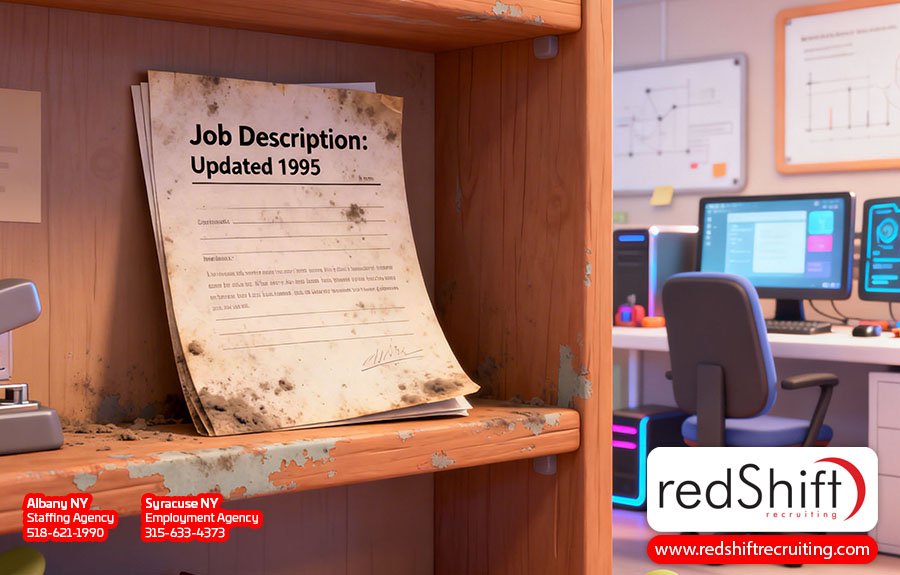
How Roles Expanded Beyond What the Market Can Support
Those workforce assumptions didn't simply weaken over time—they quietly shaped how roles evolved. As organizations adapted to changing demands, responsibilities were added, tasks were consolidated, and operational gaps were absorbed into existing positions. The process rarely happened by design; it happened in response to immediate pressures, one adjustment at a time, often without a corresponding look at the broader work design implications. Along the way, smaller routine tasks—the kind that don't always appear in formal job descriptions but still consume real time and attention—accumulated inside roles that were never built to hold them.
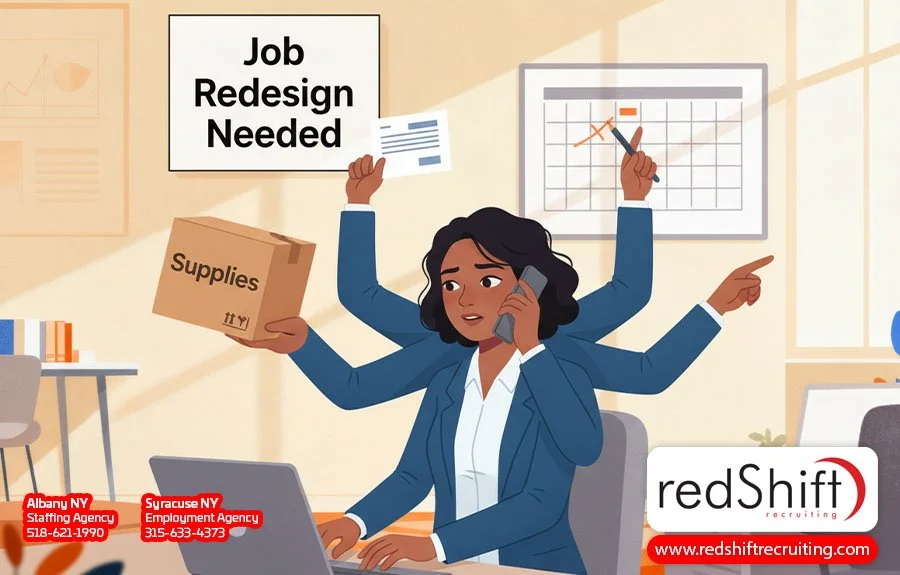
The result, in many cases, is job descriptions carrying a scope far broader than originally intended. Work that was once distributed across multiple positions now sits with a single employee, raising both the complexity of the role and the range of skills needed to perform it effectively. In healthcare, for example, clinical staff increasingly absorb administrative and coordination tasks that were once handled by dedicated support roles. In logistics and manufacturing, lead operators often carry responsibility for training, quality checks, and workflow coordination alongside their core production duties—requirements that, in more fully staffed environments, would belong to separate positions. Meanwhile, in office and administrative settings, coordinators and assistants may take on assignments across scheduling, reporting, customer communication, and project support, effectively covering multiple functional areas within a single role.
In a stable labor market, this kind of gradual expansion was manageable. In a constrained one, it becomes visible and problematic. Roles grow harder to fill, candidate pools narrow, and the expectations embedded in a job posting can quietly disqualify a large share of otherwise viable applicants. What felt sustainable in the past is increasingly difficult to maintain under current conditions.
At that point, the challenge is no longer just a hiring problem. It's a structural one: whether the role itself is still organized in a way that today's workforce can realistically support, and whether that structure serves the long-term needs of the organization.
Work Is Made of Tasks—Not Just Jobs
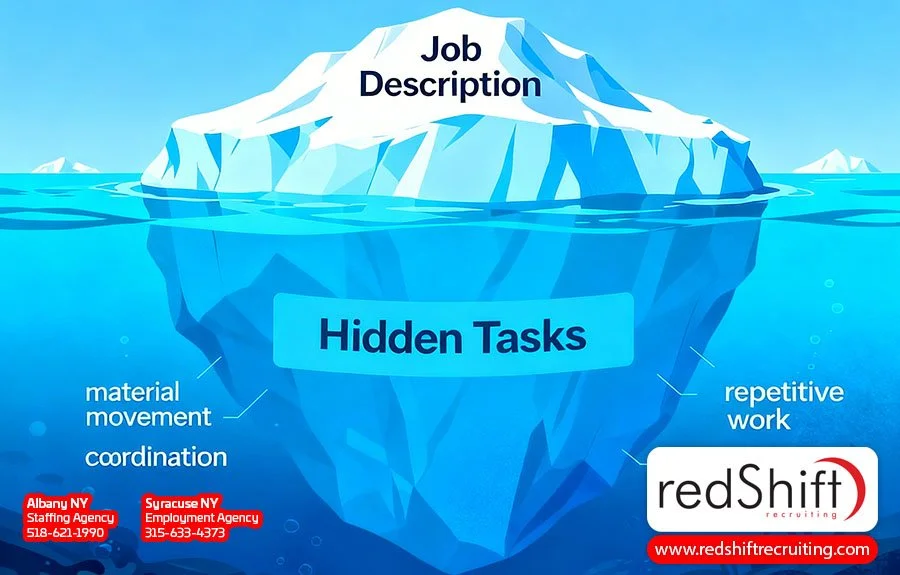
Most organizations think about workforce challenges in terms of jobs—who's in the role, whether it's filled, and how quickly a replacement can be hired. But work isn't actually performed at the job level. It's performed at the task level, and that distinction becomes critical when labor pipelines are constrained.
Every role is made up of dozens of smaller actions that need to happen consistently for operations to function effectively. Many of these tasks are easy to overlook precisely because they're routine: material movement, coordination between teams, support work, repetitive handling. They don't always appear prominently in job descriptions, and they rarely come up in conversations about strategy. But they consume significant resources, and when they're unevenly distributed across roles, they quietly pull workers away from the work where they create the most value.
This is what task concentration looks like in practice. A relatively small number of routine tasks can absorb a disproportionate share of capacity within a role, leaving higher-skilled employees spending more time maintaining basic operations than contributing at the level they were hired for. Over time, this affects both productivity and the employee experience—roles become more fragmented, expectations feel misaligned, and the gap between what a position was designed to do and what it actually requires widens.
The operational consequences compound quickly. Bottlenecks form when routine work goes undone. Workflows slow even when headcount looks sufficient on paper. And when organizations respond by adding more responsibility to existing roles or raising hiring requirements, they're often reinforcing the same structural problem rather than resolving it. In environments where tasks carry compliance or safety implications, inconsistent ownership introduces additional risk—another reason treating roles as fixed, unchanging units can be costly to maintain as conditions continue to evolve.
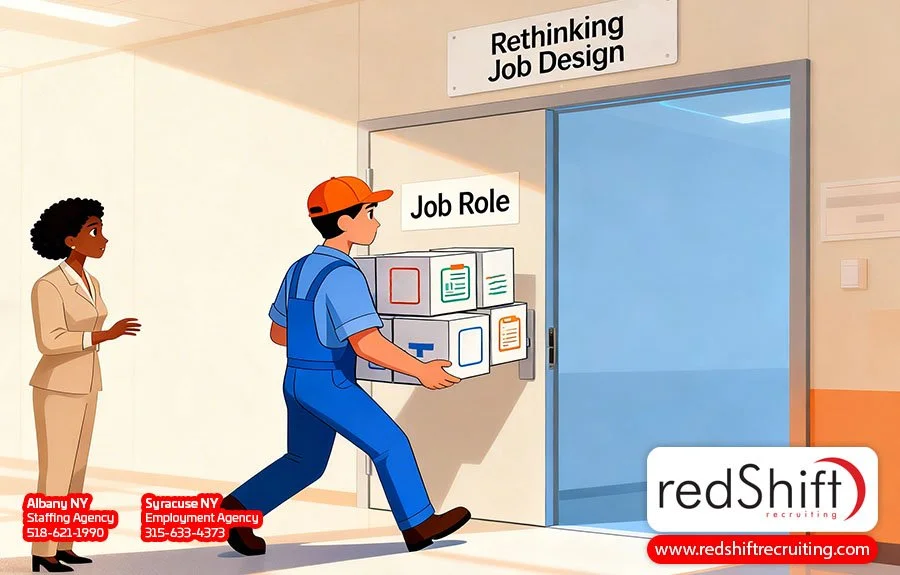
This is why a task-based lens tends to produce more useful insights than a job-based one. It shifts focus from titles and headcount to the actual work that needs to get done: where effort is going, where bottlenecks are forming, and where the distribution of work no longer matches the people available to perform it. For HR leaders and operational decision-makers, this perspective is becoming increasingly relevant as the conversation around redesigning work moves from theory to practical necessity. It also opens the door to thinking about roles more flexibly—not as fixed containers, but as bundles of tasks that can be structured in different ways.
What looks like a hiring problem is often a design problem in disguise. And design problems don't get solved by hiring more people.
Where the Mismatch Becomes Visible
The signals tend to appear gradually, and they rarely announce themselves as structural problems. Roles stay open longer than expected. Qualified applicants become harder to find. Hiring managers look for experienced professionals instead of entry-level employees just to maintain basic operations, while existing employees absorb additional responsibilities that keep stretching the boundaries of their roles. In many organizations, these patterns are treated as isolated hiring challenges, each one addressed separately through recruiting efforts or compensation adjustments, without examining what they have in common.
What they often have in common is the role itself.
Increasing pay can make hiring more competitive, and expanding recruiting efforts can widen the candidate pool. But neither approach addresses whether the job is structured in a way that aligns with the work opportunities actually available in the market. When the role itself is the constraint, filling it becomes harder regardless of what surrounds the hiring process. And when organizations expect more from candidates without revisiting what the role requires, the gap between what employers need and what candidates can realistically deliver keeps widening.
The consequences extend beyond hiring. As responsibilities become less clearly defined and workloads broaden, strain builds across the workplace in ways that affect more than individual performance. Team engagement drops, labor costs rise, employee mental health comes under pressure, and company culture begins to shift gradually, and often quietly, until the effects are visible in turnover, absenteeism, or team dynamics that are harder to repair than they were to prevent. In many organizations, these downstream effects are where structural misalignment first becomes impossible to ignore.
At that point, the issue is harder to attribute to any single factor. Some roles are difficult to fill not because the work lacks value, but because the way it is structured no longer reflects how labor is available. That's a different problem than a supply shortage—and it calls for a different response.
How Leadership Perspective Begins to Shift
Leaders closest to operations are often the first to notice that something structural is off, even if they don't initially frame it that way. What starts as a recurring hiring problem—the same role proving difficult to fill, the same gaps reappearing after each round of onboarding—gradually starts to feel like something else. The staffing challenge doesn't resolve because the underlying structure of the work hasn't changed.
Over time, the questions leaders are asking begin to shift:
Which tasks genuinely require specialized skill?
Which responsibilities are consuming disproportionate capacity?
Where are the bottlenecks actually forming?
The focus moves from who can we hire to how is this work structured, and that opens up options that weren't visible when the problem was framed purely as a supply issue. Some organizations begin exploring shared services or cross-functional support arrangements. Others look at how responsibilities can be redistributed across roles to reduce overload and improve productivity without simply adding headcount.
These aren't always sweeping changes. Often they start incrementally, in the form of a quiet recognition that the current structure isn't working, followed by small adjustments that reflect a new approach to how work gets organized. But even incremental changes require confronting the human element of redesign. Restructuring work affects people, not just workflows. The goal isn't only to maintain output under pressure—it's to do so in a way that gives employees a genuine opportunity to develop new skills, stay engaged, and contribute at a level that's sustainable over time.
This shift in perspective is becoming more common across industries, and it reflects something broader than a response to short-term staffing pressure. It's part of a wider reckoning with how organizations need to operate in a new era of work where the assumptions that shaped traditional role design are no longer reliable, and where the structure of work itself has become a strategic question rather than a background detail.
The constraint, at this stage, becomes clear: it's not just about finding more people. It's about whether the work is designed in a way that the available workforce can actually support.
Are Your Roles Designed For Today’s Workforce?
When roles become harder to fill, it’s often treated as a hiring challenge—but the issue may run deeper. As responsibilities expand and tasks accumulate, some roles no longer align with the workforce available to support them. Over time, that misalignment can slow hiring, increase pressure on teams, and make it harder to sustain consistent operations.
Frequently Asked Questions
How Is Work Design Evolving to Meet the Demands of a Changing Labor Market?
Organizations are increasingly moving away from filling fixed roles and toward building systems that can adapt as conditions change. Across the world, organizations are exploring ways to structure work with greater flexibility by breaking responsibilities into more manageable components, creating more sustainable workflows, and moving away from a status quo that was built for a more stable labor environment. This shift is reshaping what the future of work looks like in practice, not just in theory.
Part of that workplace design evolution involves integrating machine learning technology and tools like generative AI, which can absorb certain routine or process-driven tasks and free employees to focus on work that requires judgment, context, and human insight. The goal isn't to replace people, but rather to make better use of them by ensuring the structure of work actually reflects what people do best.
How Can Organizations Balance Efficiency With the Human Element of Work?
Efficient operations don't have to come at the expense of the people doing the work, but they require deliberate choices about how roles are designed. When efficiency improvements are layered onto roles that are already overstretched, the result is often higher output in the short term and higher turnover not long after. Designing for sustainability means building in space for creative thinking, meaningful contribution, and a sense of purpose that keeps people engaged over time.
This balance matters practically, not just culturally. Organizations that invest in retaining talent by creating impactful jobs—roles where employees can genuinely contribute and grow—tend to see stronger engagement and better long-term outcomes than those focused purely on squeezing more productivity from existing structures. The human element of work isn't separate from performance. In most cases, it's what drives it.
How Can Internal Talent Marketplaces and Agile Talent Pools Support More Flexible Work Designs?
Internal talent marketplaces and agile talent pools are approaches that allow organizations to distribute work more flexibly, rather than locking all responsibility into fixed roles. Instead of assigning every task to a single position, these models make it easier to match people to specific projects or needs based on their skills and availability, giving both the organization and its employees more options for how work gets done.
The benefits extend in both directions. Employees gain exposure to new areas and have opportunities to develop new skills outside the boundaries of a single role. Meanwhile, organizations gain the ability to respond more effectively to shifting demands without overloading permanent employees or defaulting to external hiring. These models also tend to encourage collaboration across teams that might not otherwise interact, identifying capabilities that traditional role structures can hide. Together, these advantages make it easier to adapt how work is structured over time, without having to rebuild roles from scratch each time conditions change.
How Can Organizations Use Research and Data to Improve Job Design?
Rethinking how work is structured doesn't have to start from scratch. Organizations that take a task-level approach—systematically examining where time is actually going, where bottlenecks are forming, and which responsibilities are consuming disproportionate capacity—often find that the research needed to redesign roles is already embedded in day-to-day operations. The challenge is creating the space and structure to surface it.
As new technology makes it easier to analyze workflows, track task distribution, and model different role configurations, organizations have more tools available to inform these decisions than ever before. The same analytical thinking that drives improvements in product design, such as iterating based on evidence, testing assumptions, and refining based on resultscan be applied to how work itself is designed. Organizations that bring that mindset to role structure are better positioned to build jobs that are sustainable, fillable, and aligned with the workforce available to perform them.
How Can Rethinking Job Design Create a Competitive Edge?
In a constrained labor market, the organizations best positioned to compete aren't necessarily those offering the highest salaries—they're often the ones that have made their roles easier to fill, easier to perform, and easier to grow within. Aligning workplace design more closely with available skills and realistic capacity allows companies to better utilize the employees they already have, bring more people in through roles that are genuinely accessible, and reduce the churn that comes from roles that are already overwhelmed.
Over time, this creates a compounding competitive edge. Impactful jobs that give employees a clear sense of contribution improve talent retention, strengthen engagement, and build the kind of organizational resilience that's difficult to replicate. As workforce conditions continue to evolve, companies that have moved beyond the status quo of fixed, assumption-laden role design will be meaningfully better equipped to adapt—and to attract and keep the people they need to do it.
Conclusion: From Job Descriptions to Work Systems
The workforce challenges most organizations navigate today are real—but they're not always what they appear to be. What looks like a hiring problem, a retention problem, or a compensation problem is often something more fundamental: a mismatch between how work is structured and the workforce available to perform it. Roles built for a more stable labor environment don't automatically adapt when conditions change, and the gap that opens up doesn't close on its own.
Addressing that gap means being willing to examine the structure of work itself—not just who is filling the roles, but whether the roles make sense given the labor market organizations are actually operating in. That's not a simple undertaking, but it's increasingly a necessary one. The organizations that treat job design as a living part of their operational strategy, rather than background infrastructure written once and rarely revisited, will be better positioned to build teams that are sustainable, resilient, and genuinely capable of performing the work ahead.

Article Author:
Ashley Meyer
Digital Marketing Strategist
Albany, NY