
Leadership Burnout in a Labor Shortage: When Coverage Replaces Progress
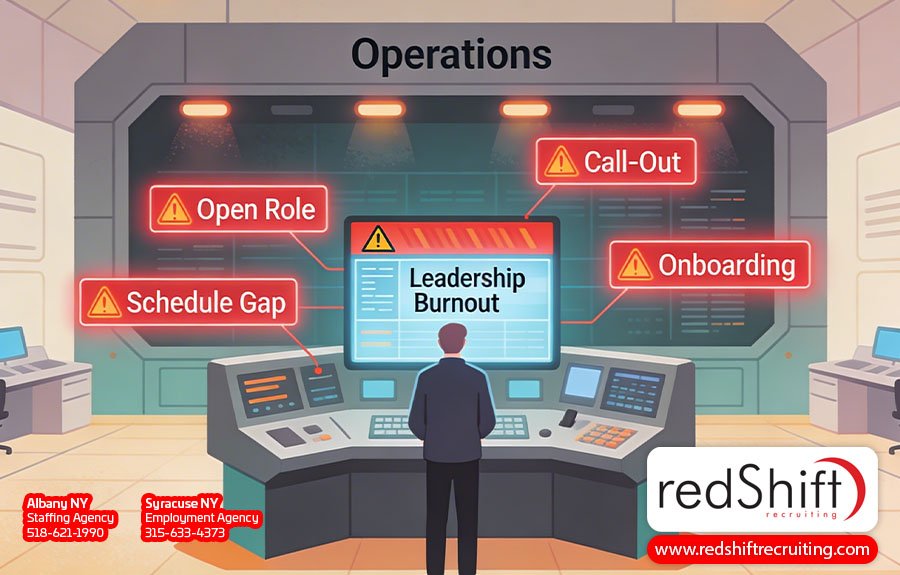
There's a quiet assumption baked into most leadership roles: that someone else is doing the frontline work. Leaders plan, develop, and improve—because the team is there to execute. But in a sustained labor shortage, that assumption stops reflecting reality.
Many leaders start their day not with strategy, but with a coverage gap. Who called out? Who hasn't been replaced yet? Who's been on overtime three weeks running? Because coverage gaps don't wait for a good time. Neither do call-outs, departures, nor the simple fact that a new hire at week two isn't the same as a seasoned employee at year two.
This is where leadership burnout actually begins—not in the emotional weight of the job, but in the structural displacement of it. The World Health Organization defines burnout as a syndrome caused by unmanaged chronic workplace stress, marked by exhaustion, mental detachment, and reduced effectiveness. In day-to-day operations, that looks like less energy for strategic work, more distance from the role leaders were hired to do, and a steady loss of momentum on priorities that require sustained attention. The definition isn’t new; what’s changed is how consistently the conditions behind it are showing up. They’re no longer occasional; they’re structural.
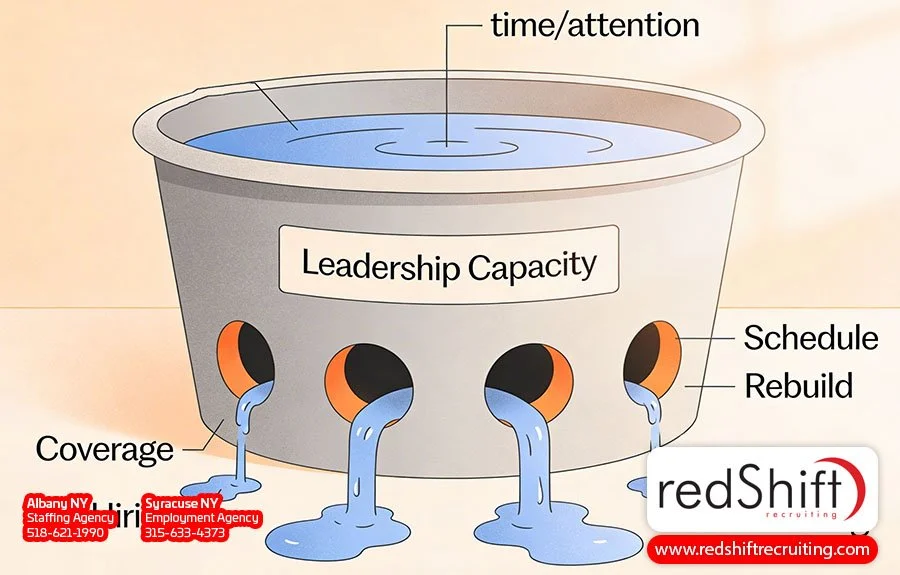
When leaders spend their day on stabilization instead of improvement, the organization loses more than their time. It loses the thinking, planning, and development work that only happens when leaders aren't stuck filling holes. A labor shortage doesn't just create open positions. Over time, it quietly redefines what leadership work looks like day to day.
How Staffing Gaps Become Daily Coverage Work
Open roles rarely appear on a leader’s radar as a strategic risk. They show up as a 6:00 a.m. text, a reshuffled schedule, or a last-minute decision about who can stay late. But gradually, these moments stop being exceptions and start defining the day.
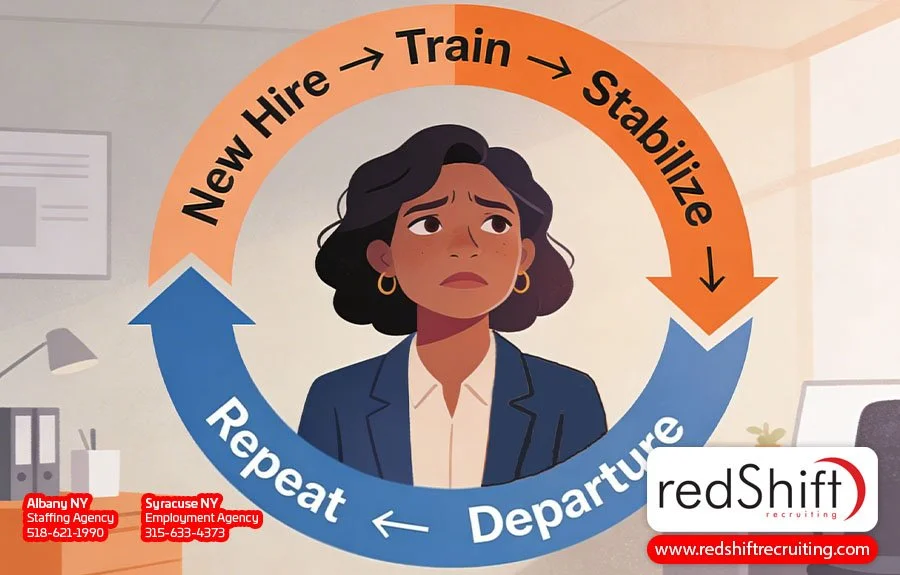
For many leaders, the first priority is no longer what moves the business forward, but what has to be stabilized before anything else can happen. Call-outs require immediate action. Vacancies stretch across weeks or months, forcing repeated adjustments. Even successful hires don’t restore capacity right away, and onboarding adds new tasks for experienced employees, who must step away from their own work to train them. The gap doesn’t disappear; it just changes form.
This is where the structural shift occurs. Work that was once handled across a fully staffed team moves upward, as leaders step in to solve short-term coverage problems that didn’t previously reach their level. None of this is unusual on its own; the difference is the frequency. When it happens every day, it resets what the leadership role actually is.
In that environment, the strain isn’t defined by a single bad day or a temporary spike in workplace stress. It comes from the steady transfer of operational responsibility. Leaders may still be meeting expectations, but they have less control over how their time is used and less space for the work they were hired to lead.
Left unaddressed, stabilization stops being a disruption and becomes the job.
The Displacement of Core Leadership Work
Coverage work doesn’t just take time—it replaces other types of work. Every hour spent rebuilding a schedule, redistributing assignments, or stepping in to complete a task is an hour not spent seeking new opportunities or improving how the operation runs. The loss is not measured only in hours. It's measured in the work that requires uninterrupted attention: redesigning a process, identifying and developing future revenue streams, addressing recurring performance issues, or stepping back to evaluate long-term outcomes. These responsibilities remain part of the role’s formal expectations, but the space to do them keeps shrinking.
Leaders are still accountable for results, employee morale, and team development, but with less time to shape the conditions that produce them. Decisions happen faster, with fewer options and less opportunity to gather data and assess whether earlier changes are working. Over time, that changes how the business performs, even when individual leaders are putting in significant effort.
Fewer proactive check-ins with colleagues and less time to strengthen working relationships are capacity constraints, not cultural choices. The expectations of the role stay the same; the environment around it does not. When the time and space for forward-looking work disappears, progress slows and the organization loses the ability to support innovation, pursue new initiatives, and respond to competitive change.
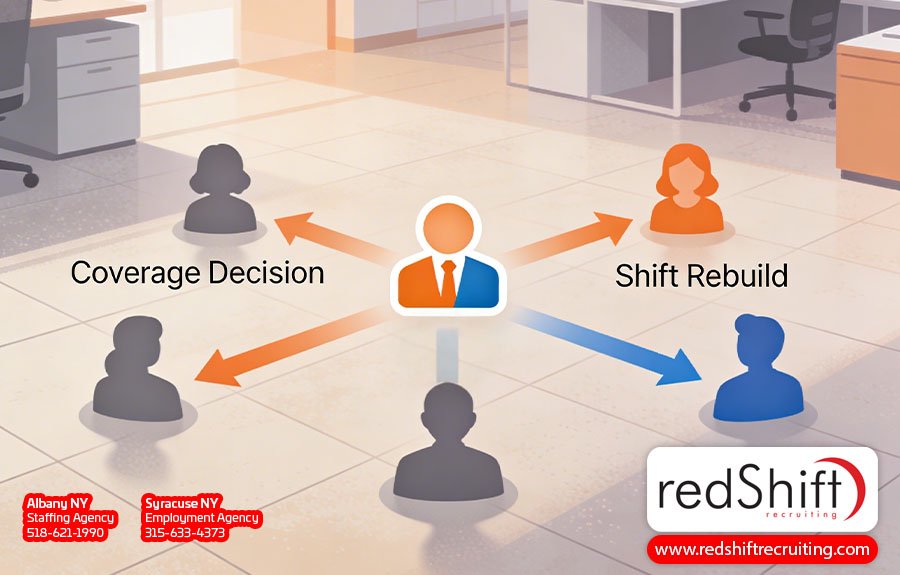
Continuous Re-Prioritization in a Constrained Workforce
In a short-staffed operation, the day rarely runs as planned. New gaps appear, conditions change, and leaders find themselves pushing deadlines and rearranging schedules again and again.
The tradeoffs are operational and familiar: maintain service levels or reduce overtime, pull a high performer into coverage or keep a project moving, delay an improvement initiative or ask an already stretched team for more. The challenge is the frequency. When these decisions happen at high levels every day, the role becomes a continuous exercise in short-term prioritization.
At that point, the strain shifts from time to attention. Leaders are still responsible for meeting performance expectations, but they’re doing it in an environment where priorities change midstream and there’s less and less room to see whether a strategy actually worked. Over time, that limits a leader’s influence over outcomes—not because they aren’t competent, but because the conditions they’re working in keep changing.
This dynamic is a major contributing factor to burnout in leadership roles. It isn't an issue of commitment, work ethic, or time management; it's the cumulative weight of repeated tradeoffs and the lack of recovery time between them. Without the right support, even experienced leaders are likely to struggle in a high-pressure environment where they’re operating in constant response mode, with limited time to evaluate decisions, plan new initiatives, or develop their teams.
The Shift from Team Building to Gap Management
Traditional leadership roles are built around growth: building teams, developing people, improving performance, and planning for what comes next. Coverage work existed, but it was the exception—not the center of the role.
But when teams are understaffed, that balance flips, and a growing share of a leader's role is spent maintaining minimum coverage, redistributing workload, and absorbing the impact of departures. The focus moves from building business capacity to preserving day-to-day operations.
It often shows up in simple questions: Over the past year, how much time have we spent developing future supervisors? How often have we stepped back to plan for growth? When was the last time performance improvements weren’t pushed to next quarter? If the answers show a lack of investment in team development and long-term improvement, it isn’t necessarily a leadership failure—it may be a sign the role has shifted from moving the business forward to simply keeping it running. That shift does more than change the workflow; it takes away the time leaders need to do the work that actually creates impact.
Redefining the leadership role has consequences. Teams receive less coaching. Top employees have fewer opportunities to grow. Performance conversations become shorter and more tactical instead of constructive opportunities for professional development. Eventually, that strain begins to cascade through the group, affecting engagement, performance, and retention. And as more time is spent on coverage and redistribution, less time is available for the work that creates stability in the first place.
The Compounding Effect on Organizational Stability
The impact of leadership capacity loss rarely shows up all at once. It appears gradually, in small shifts that are easy to explain away: a delayed initiative, a slower response to market changes, a training program that keeps getting postponed. Each decision makes sense in the moment. But together, they change how stable the organization really is.
When more leadership time is consumed by filling gaps and putting out daily fires, fewer hours are available for the work that prevents disruption in the first place. Process improvements are delayed, and market or competitor research isn't done. Successors are not prepared, or even chosen. Performance issues take longer to correct, contributing to more mistakes and greater operational inconsistency. Even when new hires are brought in, the surrounding systems are too overloaded to invest the training time needed to bring them up to full productivity.
These factors continuously reinforce the cycle. Instability requires more attention, and that attention reduces the time available to build the conditions that create stability. Hiring continues, and leaders may reasonably hope the next addition to the team will restore balance, but relief arrives slowly and is often short-lived as new gaps emerge.
This dynamic affects the entire organization. Decisions become less consistent, and priorities shift more often, reducing employee morale and confidence in leadership as sustained burnout makes critical choices harder to carry through. Meanwhile, lack of training and limited growth opportunities mean there are fewer people ready to step into gaps when needed. For this reason, burned-out leaders are not only an individual concern; they are an early signal of reduced organizational resilience. When leadership capacity is consistently redirected toward short-term stabilization, the organization loses some of its ability to adapt and sustain performance under pressure.
Why Leadership Burnout Is a Capacity Problem—Not a Resilience Problem
On the surface, recognizing burnout symptoms in leadership roles can seem like an assessment of a particular person: signs of personal fatigue or anxiety, shorter planning windows, fewer forward-looking conversations, and more reactive decision-making. That makes it easy to frame the issue as one of individual coping, mindset, or self-care. But that framing can be deceptive, encouraging burnout to be viewed as an isolated issue while the real driving force behind it goes unexamined.
Understanding burnout in the workplace starts with recognizing that the work has changed shape. Temporary coverage becomes a daily responsibility, and periodic issues become regular hurdles. Leaders are still expected to achieve the same goals, but with less time, fewer resources, and a much less stable environment. The question isn’t whether an individual leader is struggling in a high-pressure environment, but whether the structure of the work allows them to focus, plan, or develop their team at all. When the work environment no longer provides those conditions, activity increases but forward progress does not, and no amount of personal effort or better time management can close that gap.
This is why the conversation cannot be reduced to how to prevent burnout or how to produce better leaders who can handle a changing environment. Addressing those issues is important, but they don’t resolve the larger constraint: many leaders are now operating in a system where the volume and demands of the work exceed the time and support built into the role.
Reframing the issue this way changes the question, moving the focus away from “Why can’t leaders keep up?” and toward “What happens when the work itself outpaces the people responsible for it?” That shift restores clarity, removes misplaced blame, and helps organizations identify the real constraint: not commitment or capability, but the mismatch between what leadership roles were designed to do and what they are now required to absorb.
Seeing This in Your Organization?
If your leaders are spending more time rebuilding schedules than developing people, if strategic work keeps getting pushed to “next quarter,” or if filling roles hasn’t restored the time needed to move key initiatives forward, you’re not looking at a performance issue. You’re seeing the operational impact of sustained staffing instability on leadership work.
Frequently Asked Questions
How Can Managers Recognize Burnout Warning Signs in Leaders During a Labor Shortage?
The most visible warning signs of leadership burnout are often operational, not personal. Work that used to focus on development, planning, and performance improvement shifts toward daily coverage, repeated schedule changes, and constant short-term decisions. Over time, that creates chronic workplace stress, reduced focus and energy, and a noticeable drop in the time available for strategic thinking and planning.
This pattern doesn’t affect only one job or one individual. When leaders spend most of their day stabilizing operations, teams receive less coaching, professional relationships become more transactional, and productivity slows across the entire organization. Many leaders don’t immediately recognize this as burnout because it doesn’t begin with disengagement—it begins with sustained pressure, expanding responsibilities, and the feeling that there is no uninterrupted space to do the work they were hired to do.
Why Is Leadership Burnout a Structural Problem, Not Just a Personal One?
Leadership burnout in a labor shortage often looks personal because it shows up in individual behavior and affects personal well-being. But while there are many reasons for individual burnout, the underlying cause may be structural. When leaders are regularly absorbing ongoing coverage responsibilities or taking on work that falls outside their defined scope, the mismatch between expectation and reality creates a sustained pressure regardless of the person's skill, experience, or commitment.
Framing burnout as a personal issue puts the focus on coping strategies instead of the operating conditions that are driving it. Addressing burnout with empathy and care is an important aspect of responsible employee support, but it can oversimplify the organizational conditions that are producing it. In contrast, framing it as a structural issue helps employers see it for what it is—a signal that the role, the workload, and the available support are no longer aligned.
How Can Organizations Address Burnout and Support Leadership Well-Being in a Labor Shortage?
Efforts to address burnout are most effective when they focus on restoring capacity rather than asking individuals to simply manage higher levels of stress. In constrained environments, the issue is rarely motivation or commitment, but rather the mismatch between what leaders are responsible for and the time and support available to do it.
Protecting leadership well-being starts with recognizing that constant coverage work changes decision quality, slows progress, and limits the ability to support employees, lead initiatives, and develop future leaders. Clear priorities, realistic spans of control, and consistent operational support create the conditions that allow leaders to make important decisions with confidence, stay connected to their teams, and sustain performance without the ongoing cycle of chronic stress and exhaustion.
For leaders dealing with high levels of anxiety or a sense of isolation that begins to affect their day-to-day work, sleep, or overall quality of life, recent research points to the value of external support. In those situations, access to a licensed therapist or other qualified resource gives leaders a confidential space to understand burnout and process the demands of the role in a way that internal conversations often cannot.
Can Organizations Prevent Burnout Without Reducing Leadership Responsibility?
Most efforts to prevent burnout focus on individual coping strategies, but in a labor shortage, one of the primary drivers is chronic workplace stress created by ongoing operational instability. When leaders are repeatedly pulled into coverage, the result is not just longer hours. It is emotional exhaustion, reduced decision capacity, and less time to support the people around them.
This is why experiencing burnout symptoms in these environments is rarely a sign of weak motivation or poor time management. It reflects a gap between expectations and available capacity. Creating psychological safety and strengthening social support inside leadership roles helps, but those factors are most effective when they are paired with realistic scopes of responsibility and consistent operational stability. Without that alignment, even highly committed leaders will see their energy, focus, and effectiveness gradually decline.
What Is the Long-Term Cost of Leadership Burnout for Employers?
The long-term cost of burned-out leaders isn’t just individual exhaustion: it’s what stops happening inside the organization. When leadership time is consumed by daily stabilization, there is less room for developing future leaders, improving processes, strengthening coordination across teams, and pursuing new opportunities. Execution slows, decision quality becomes more variable, and fewer people are ready to step into critical roles when gaps appear.
Over time, this reduces an organization’s ability to adapt and move forward with consistency. Leadership roles are designed to provide direction and momentum; when they are pulled into continuous coverage, the business loses some of its strategic power. Leaders are no less capable, but the system no longer gives them the space to do the work that creates stability and growth.
Conclusion: The Hidden Limit on Organizational Performance
Leadership burnout in a labor shortage is often treated as a question of endurance—whether experienced leaders can handle the pace and pressure of the role. But the current pattern shows something different. When coverage, stabilization, and constant reprioritization become the core of the job, the issue isn’t individual resilience or work ethic; it’s the growing gap between what leadership roles were designed to do and what they actually do. The result isn’t just personal strain; it’s slower progress, less consistent execution, and an organization that spends more time maintaining itself than moving forward.
That shift has consequences beyond the leadership level. When the work of stabilizing essential roles stretches out over longer periods, the time and space required for teaching, coaching, and building the next layer of leadership begin to shrink. This operational reality—where key positions take longer to reach full effectiveness and experienced employees have less time to pass on what they know—is reshaping how work is learned, handed down, and sustained across the organization.

Article Author:
Ashley Meyer
Digital Marketing Strategist
Albany, NY