
How to Improve Your Hiring Process: Questions Every Employer Should Ask
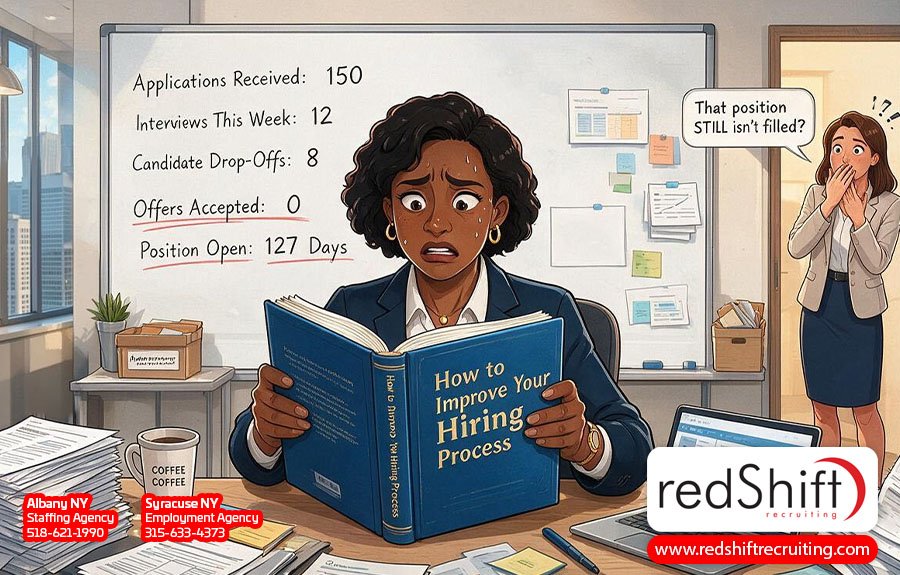
If you work in leadership, human resources, or talent acquisition, you probably know the last time your company reviewed its budget, technology, or business strategy. But when was the last time your hiring process received the same attention?
A few months ago, we began implementing a new applicant tracking system. The transition has brought both expected and unexpected challenges, but it also created a valuable opportunity: it required us to reexamine recruiting workflows that had developed gradually over more than 10 years. We found ourselves questioning almost every stage of our internal process, from why certain steps existed to what we wanted to do differently moving forward.
The reality is that any hiring and recruitment process can become outdated when left unexamined for too long. While many business leaders are quick to respond when customer demand shifts, costs rise, or performance begins to slip, hiring workflows do not always receive the same attention. Yet inefficiencies in hiring can significantly affect staffing goals, internal workloads, and the organization’s ability to compete for top talent.
A great deal can happen in just a few years. Companies grow or contract, responsibilities shift, new roles emerge, and candidate expectations evolve. What worked yesterday may not make sense today. When hiring fails to keep pace with the company or the job market, employers can lose time, create unnecessary work, and make it harder to keep great candidates engaged.
Understanding how to improve your hiring process doesn't mean starting over from scratch. It begins with stepping back from familiar routines and reviewing how hiring actually works today. In this article, we’ll explore why periodic reviews matter, what employers should evaluate, and how to turn what they uncover into meaningful improvements.
Why Is It Important to Review Your Hiring Process?
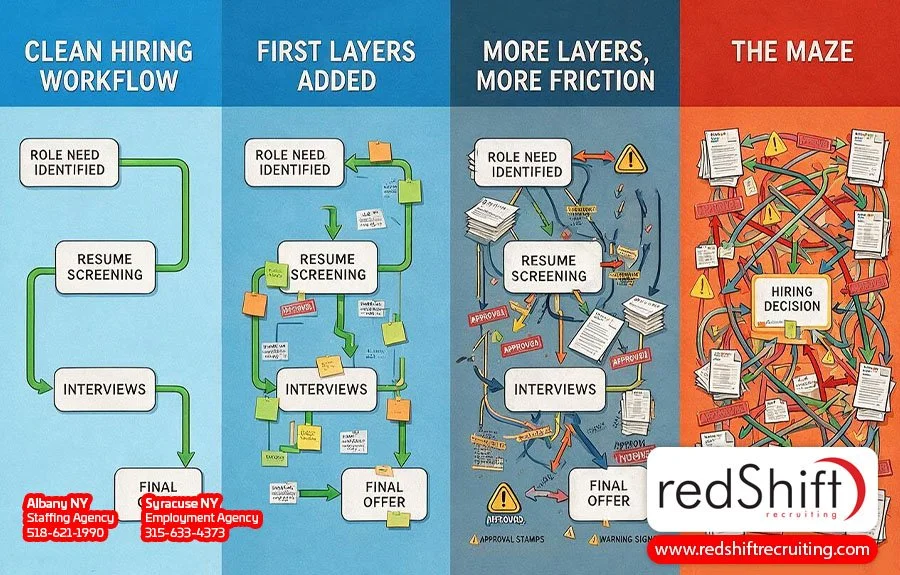
Most hiring workflows were not designed all at once. They developed gradually as employers responded to individual problems, new priorities, and shifting responsibilities.
For example, a hiring manager may have asked the company owner to join the final interview for one especially complex role. That extra conversation may have been necessary at the time. But if additional managers are later brought into the process and those interviews become standard for every opening, candidates could eventually face six or seven separate interview stages. What began as a reasonable safeguard can become a daunting process that discourages even the best candidates.
The same pattern can appear in other parts of the process. A department head may have been added as an approver during a period of rapid growth, even though that person no longer works closely with the role. Recruiters may enter the same candidate information into multiple systems because an old workaround was never removed. Or two managers may conduct separate interviews but ask nearly identical questions because no one clarified what each conversation should evaluate.
Each of those steps may have been added to solve a real problem. The issue arises when they accumulate, outlive their original purpose, and remain in place simply because no one has reviewed the process as a whole.
These inefficiencies are easy to miss because employees learn to work around them. Open roles still get filled, so the process appears to be working even when it requires more effort and creates more delays than it should.
By intentionally reviewing hiring procedures, business leaders, HR professionals, and recruiters can look beyond whether a position was ultimately filled and examine how the organization reached that outcome. Does the process still support current hiring objectives? Does each person’s involvement add value? Is the time required actually leading to better decisions? The review should also consider the process from the job seeker's perspective. Is the candidate experience helping the organization engage great talent, or is it driving potential employees away?
Creating a good hiring process doesn't mean removing every approval, shortening every interview, or changing a procedure simply for the sake of speed. Some steps genuinely help employers evaluate risk, compare qualified candidates, or make a stronger hiring decision. The goal is to remove unnecessary friction by distinguishing those useful safeguards from steps that remain only because no one has revisited them. Before employers decide what to change, however, they first need to understand what each step is accomplishing.
Questions That Can Reveal Opportunities for Improvement
Once employers decide to review their hiring process, the next challenge is knowing where to begin. Looking at the entire process at once can feel overwhelming, especially when several departments, decision-makers, and technologies are involved.
A more practical approach is to examine each stage individually, from identifying a new job opening to the point when a candidate accepts the job offer. At each stage, ask:
Why does this step exist? Identify the need it was originally intended to address. Was an approval added after a difficult hiring decision? Was another interview introduced for one unusually complex role? Understanding the history can help determine whether the original need still exists.
Does it still add value? Consider whether the step provides new information, reduces a valid risk, or improves the decision-making process. If removing it would not affect how the organization evaluates potential hires, it may no longer justify the time it requires.
Would we design it this way today? This question separates intentional choices from inherited habits. If the company were building a structured hiring process now, would it include the same interviews, approvals, forms, and handoffs?
Does the process help us reach the right candidates? Review where applicants are coming from and whether those sources still fit the roles you need to fill. A channel that produces many candidates is not necessarily effective if it doesn't reach the right candidates for the role. Depending on the position, an employee referral program, a partnership with a local college, or more targeted outreach may produce stronger results, as well as tap into a more diverse candidate pool.
Is ownership clear? At every stage, someone should be responsible for the next action, know what information is needed, and understand when it should be completed. Clear ownership helps keep HR and hiring managers on the same page and prevents tasks from stalling between departments.
Is each step happening at the right time? Even useful steps can create friction when they occur too early or too late. Candidates should not reach the end of the selection process before learning the schedule, work arrangement, or salary range, and essential decision-makers should not enter only after several interviews have taken place.
Is the process discouraging candidates? Consider the effort required at each stage. Applications that require the same information multiple times, excessive assessments, and unnecessarily long interview processes can all cause strong applicants to withdraw before the offer stage. Even great job candidates may decide that the opportunity is not worth a burdensome process.
Are candidates receiving timely, useful communication? Consider what job applicants hear after applying, after a phone screen, between interviews, and while awaiting a final decision. Candidates should know what comes next, when they can expect an update, and important details about the role early enough to avoid preventable surprises.
Are people spending their time where it has the greatest impact? Look at how time is being used throughout the process. If scheduling, duplicate data entry, repeated follow-up, or low-value interviews consume a large share of the workload, that time may not be used for the activities that most influence hiring outcomes.
Together, these questions help employers look beyond old habits and assess whether each stage is actually making the process clearer, more consistent, and more useful for both the people responsible for hiring and the job seekers moving through it.
What Your Hiring Process May Be Telling You
Assessing your recruitment process will not always reveal a single obvious problem. More often, it exposes patterns such as recurring delays, repetitive tasks, unclear handoffs, or points where candidates regularly lose interest.
Those patterns can reveal a great deal about how well the process is functioning.
Communication delays may reveal broader process Problems
When candidates wait days or weeks for updates, or interview scheduling repeatedly stalls, the issue may be structural. Ownership may be unclear, the hiring manager may be overwhelmed, too many people may be involved, or the process may rely on manual steps that are difficult to maintain.
Whatever the cause, repeated delays deserve attention before they affect candidate retention and the organization’s reputation. While the hiring process is stalled, strong applicants may be moving on to other opportunities, and those who remain may come away with a poor impression of the company.
Duplicate work may signal that roles, tools, or handoffs are not aligned
Recruiters should not need to enter the same information in several places, rewrite notes that already exist, or repeatedly ask candidates for details they have already provided.
Duplicate work may result from outdated workarounds, separate departmental processes, unclear responsibilities, or recruitment software that no longer matches the workflow. Removing these repetitive tasks saves time for your team while supporting a better candidate experience.
Multiple approvals may no longer match the role
Requiring several approvals for a hiring decision isn't automatically a problem, particularly for senior, technical, regulated, or high-risk positions that may require input from multiple people.
The issue arises when an approver lacks a defined purpose or the level of review does not match the position. Hiring a new CFO may reasonably require input from several departments and executives. A customer service representative, however, can often be evaluated by a much smaller group. Adding reviewers who will rarely work with the new hire may create unnecessary delays without improving the decision.
Inconsistent interviews may produce inconsistent evaluations
Different interviewers may focus on different areas to identify the right talent. One may assess technical ability, while another evaluates soft skills or company culture fit. Together, these perspectives can produce a stronger combined assessment, but only if everyone shares the same understanding of what the role requires and how candidates will be evaluated.
Problems arise when interviewers use different standards, ask questions without a clear purpose, or rely on vague impressions that are difficult to compare. For example, one interviewer may view a candidate’s direct communication style as a strength, while another interprets it negatively. Another may place significant weight on an undefined sense of cultural fit without explaining what that means or how it relates to job performance. An effective candidate interview process gives each person a clear purpose, uses shared criteria, and helps the team reach fairer, more consistent decisions.
Candidate drop-off may reflect avoidable friction
Candidates withdraw for many reasons, including stronger offers, changing circumstances, or a decision to stay with their current employer. But if you're repeatedly losing your top applicants at the same points in the process, it's time to investigate.
Hiring is a two-way street. As employers evaluate candidates, candidates are also evaluating them. A poor experience can contribute to candidate withdrawals, declined offers, and damage to the employer brand.
Complex applications, unnecessary interviews, communication gaps, and limited transparency around job expectations, compensation, or work arrangements can all weaken a company’s relationship with job seekers. Candidates may begin to question whether the organization respects their time, is prepared to make a decision, or is serious about filling the role. By the time an offer arrives, the experience may already have convinced them to look elsewhere.
Heavy administrative workloads may be limiting recruiting activity
If recruiters consistently spend more time coordinating internal steps than speaking with suitable candidates or sourcing hard-to-find talent, the process may be relying too heavily on manual follow-up. Recruiters may also spend excessive time reviewing applications from people who don't meet the basic requirements, suggesting that the application process or sourcing strategy needs attention.
This is especially important for specialized or competitive roles, where employers may need to actively target candidates rather than wait for applications. Procedures that consume too much recruiter time can slow the overall recruiting process and limit the team’s ability to build relationships with potential candidates.

How to Use Your Review to Improve Your Hiring Process
A process review is only useful if it leads to practical changes. Once employers understand where friction exists, they can focus on the improvements most likely to make the recruiting process clearer, faster, and more consistent.
Remove steps that no longer serve a clear purpose. An interview, approval, or form should remain because it improves evaluation, reduces risk, or supports a necessary decision, not simply because it has always been there.
Clarify ownership at every stage. Decide who schedules interviews, collects feedback, communicates with candidates, and makes the final call. Clear responsibilities prevent tasks from sitting between recruiters, managers, and human resources.
Simplify candidate communication. Candidates should know what to expect, who will contact them, and when the next update is likely to arrive. Employers should look at where communication breaks down and why. The solution may involve clarifying responsibility, redistributing work, reducing unnecessary approvals, or automating routine updates through your ATS.
Respect candidates' time. Every application, assessment, and interview should earn its place in the process. Repetitive forms, lengthy evaluations, and excessive interviews can discourage even the most patient applicants. If several interview stages are necessary, consider whether the first interview can be conducted by phone and whether other conversations or assessments can be combined, shortened, or completed remotely.
Eliminate duplicate work and automate routine tasks. Look for information being entered more than once, repeated interview questions, or updates being tracked separately in forms, spreadsheets, and recruiting software. Removing duplication can save time without weakening the quality of the review. Where appropriate, automation tools or recruitment software can handle job postings, resume filtering, interview scheduling, reminders, status updates, and data transfers, giving recruiters more time to focus on candidates.
Document what changes and why. Updating the written process helps prevent teams from reverting to old habits and gives new employees a clearer understanding of how hiring should work. Documentation may include interview responsibilities, approval requirements, communication expectations, or how background checks and other final steps are handled.
Employers do not need to redesign everything at once. In fact, changing too much at the same time can overwhelm your team and make it difficult to tell what’s working. Start with the biggest issues, make one or two targeted adjustments, and observe the results. Making the hiring process efficient doesn't mean removing as many steps as possible; it means creating a process that uses time well, supports sound decisions, and helps employers hire qualified candidates.
Frequently Asked Questions
How Often Should Employers Review Their Hiring Process?
An annual review is a practical baseline, but employers should also revisit the recruitment and hiring process when business conditions change. Rapid growth, turnover, new leadership, repeated candidate drop-off, or a shift in hiring needs may all signal that the current process deserves another look.
Every review doesn't need to be extensive. Even a short discussion about recent open positions, recurring delays, and feedback from recruiters or managers can help maintain a structured hiring process that meets the company's needs.
Can an Outdated Job Description Make It Harder to Find Candidates?
Yes. An outdated job description may include responsibilities that no longer apply, overlook important skills, fail to meet competitive salary expectations, or describe a role differently from how it actually operates. That can make it harder to find candidates who match the position and may discourage the ideal candidate from applying.
Before publishing a job posting, define the hiring criteria and confirm that the responsibilities, qualifications, salary information, schedule, and benefits package are accurate. Use brand-specific language that reflects the company culture and values and concisely explains the role. Clear information helps attract candidates, sets realistic expectations, and gives job seekers a firm understanding of the opportunity.
How Can Employers Make Their Hiring Process More Efficient Without Rushing the Hiring Decision?
Efficiency doesn't mean removing every interview or safeguard. It's about deciding which steps are truly necessary, when they should happen, and whether they can be handled more simply. For example, the first interview may be more practical as a phone interview instead of in-person, while assessments, reference checks, and background checks should be scheduled early enough to prevent last-minute surprises but not so early that they waste time and money on candidates who are unlikely to move forward.
Employers can also save time by removing duplicate steps, clarifying ownership, and training hiring managers to use focused interview questions. An effective hiring process still evaluates potential hires carefully, but it does so in an order that supports a sound hiring decision without creating avoidable delays.
Who Should Be Involved in Reviewing Open Positions and the Hiring Process?
The review should include the people who manage and experience the process directly, such as recruiters, human resources, relevant managers, and other current employees who are part of the hiring committee. New hires can provide a particularly useful perspective, identifying communication gaps, confusing steps, or unnecessary delays that internal teams may overlook.
Does the Hiring Process End When a Candidate Accepts the Job Offer?
No. When a candidate accepts, the experience should transition smoothly into the onboarding process. Employers should confirm next steps, required paperwork, the start date, and who the new employee should contact with questions.
Consistent communication between acceptance and the first day can reduce uncertainty and reinforce the candidate’s decision. A successful recruitment strategy should carry through until the employee is prepared to begin, not stop as soon as the offer is signed.
A Better Hiring Process Starts With Regular Reviews
Our applicant tracking system implementation created a natural opportunity to review how we worked, but employers should not need a major system conversion or hiring problem before examining their process. Hiring conditions, workforce needs, and candidate expectations will continue to change. Regular reviews help ensure that hiring practices support today’s goals rather than decisions made years ago. Employers that continue evaluating what works, removing what doesn’t, and refining their approach will be better positioned to hire quality candidates as their needs and the job market evolve.


Article Author:
Ashley Meyer
Digital Marketing Strategist
Albany, NY