
Human Judgment in the Workplace: The Hidden Cost of Wasting It
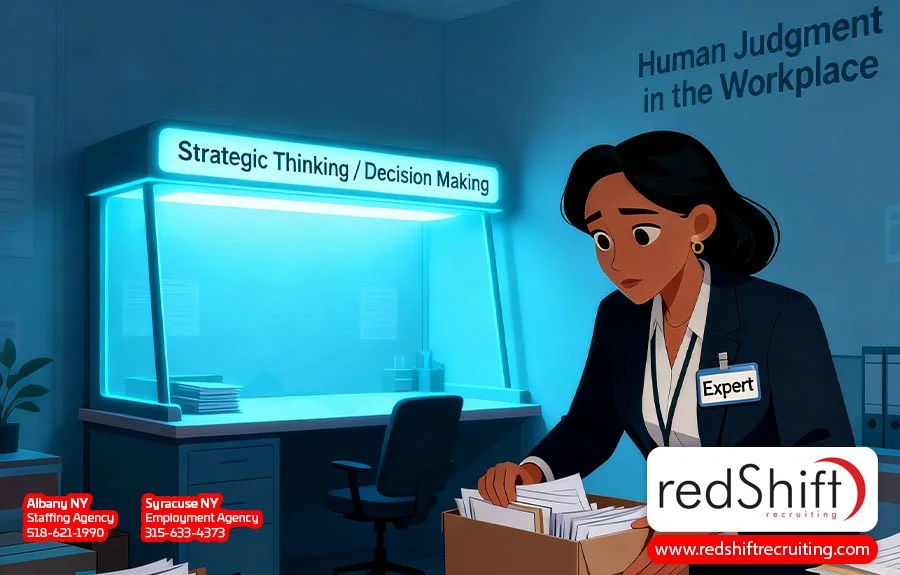
For most organizations navigating a constrained workforce, the staffing conversation has centered on numbers—not enough people, not enough candidates, not enough capacity to cover the work that needs to get done. In recent years, that conversation has grown more complicated, layered with questions about AI tools, automation, and how roles may evolve as technology continues to reshape the workplace. But there's another dimension to the problem that doesn't appear in the numbers and isn't solved by technology. It's not just how many people are in what roles—it's how those people's human intelligence, technical expertise, and critical thinking are actually being used.
Experienced workers are hired for their ability to think, interpret, and make decisions in context. But those uniquely human strengths don't always reach the work that needs them most. When skilled employees are regularly pulled into basic coordination, documentation, and gap-filling—tasks that don't require their expertise—the organization loses something that headcount reports don't capture and hiring alone can't restore. The judgment, human insight, and situational reasoning those workers were hired to provide simply go elsewhere—or, worse, are rarely used. And that misallocation can do as much operational damage as a talent shortage, quietly and consistently, long before it becomes visible enough to address.
Not All Capacity Is Equal
Staffing conversations have already evolved in useful ways. The shift from headcount to capacity measurements—recognizing that filled roles don't always mean functional operations—represents real progress in how many organizations think about workforce health. But there's a further distinction that many HR leaders and operations managers haven't fully reckoned with yet: capacity itself isn't uniform.
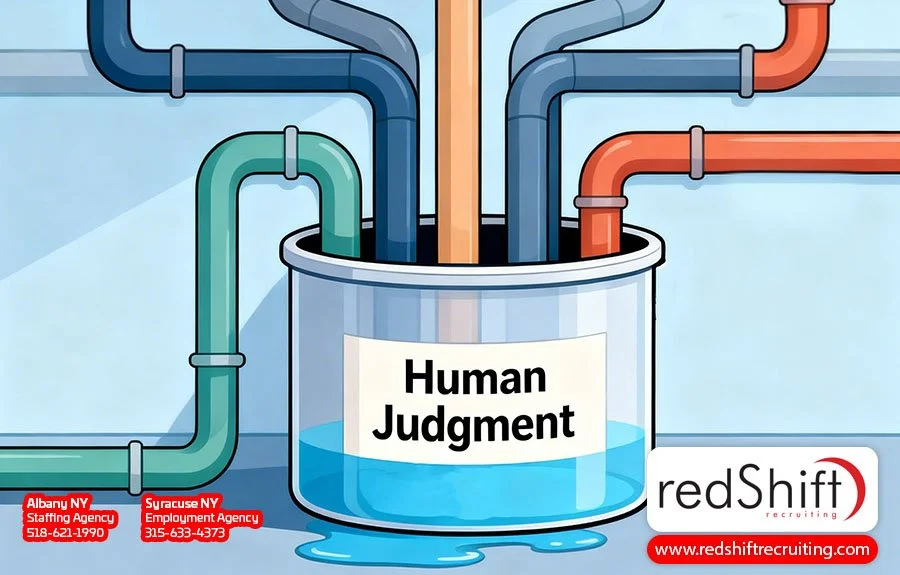
Human judgment in the workplace is not a single, interchangeable resource that scales with hours or headcount. The contextual reasoning, pattern recognition, and relational presence that experienced workers bring to their roles are distinct from the hours they're physically present, and the two don't substitute for each other in the ways workforce planning tends to assume. You can have full coverage on paper and still be short on human judgment in practice, and standard reporting won't show you the difference.
In practice, it may look like this: a skilled logistics manager, hired to oversee operations, catch process failures, and develop the people around them, spends the majority of a shift on physical inventory work because the floor is short-staffed. The work gets done; the position is filled. But the operational awareness, good judgment, and human leadership that person was specifically hired to provide—the ability to identify a problem before it compounds, to redirect resources, to mentor a newer employee—isn't always available when it's needed. It's not that covering a gap occasionally is a problem; every experienced worker does that. The issue is when it becomes the normal day-to-day.
The efficiency cost is visible, as processes slow and outputs drop. The judgment cost is less obvious, but more lasting. Because the expertise required to think through a complex problem, read a situation accurately, and build trust within a team doesn't scale by adding hours, and it doesn't automatically return once the immediate gap is covered. In many organizations, this misallocation of human ability happens across roles and levels without appearing in any metric that would prompt attention. And that's precisely why it persists.
When Skilled People Can't Do Skilled Work
In a fully staffed organization, work tends to find the right people: the maintenance engineer handles complex repairs, the data analyst works with data, and the operations manager focuses on processes, planning, and developing their team. The match between skill and task isn't perfect, but it's close enough that people are mostly spending their time doing their actual job.
Understaffed organizations don't have that luxury. When support roles go unfilled, someone has to cover the gap—and that someone is usually the most capable, most trusted person available. When there aren't enough team leads, the operations manager runs orientation. When the help desk is short-staffed, the analyst fields tickets. When administrative support disappears, professionals from other departments handle scheduling, documentation, and coordination. When there aren't enough people to maintain quality processes, the people who should be preventing problems spend their days reacting to them instead.
None of this work is without value: the orientation needs to happen; the tickets need to be answered; the documentation needs to get done. The problem isn't the work itself—it's who's doing it and what gets pushed aside as a result. A skilled welder who spends an hour every shift hunting for tools and cleaning the work area before they can start isn't less capable of those tasks—they're just not doing what they were hired to do. An accountant covering reception isn't underperforming; rather, the organization is using specialized expertise where it isn't essential. Multiply that pattern across roles, departments, and months, and the cost becomes significant even when no single instance feels dramatic.
That cumulative cost takes different forms. Sometimes it's physical exhaustion or emotional burnout—real consequences, particularly in the most demanding environments. More often, it's simply time. Skilled people regularly pulled away from higher-level work don't have the space to do what their roles actually require. Data analysis gets pushed to next week—again. Strategic planning slips. Mentorship doesn't happen. The innovation that comes from people operating at the level they were hired for gets deferred in ways that don't show up in any report, but steadily erode performance. And for the employees stuck in that cycle, it eventually raises a question the company may not want them asking: whether this is still the right place for them.
In a constrained labor market, these aren't occasional issues; they're part of the day-to-day reality. The companies feeling the most strain are often the ones redirecting their most essential human contributions away from where they matter most.
What Gets Lost When Good Judgment Goes to the Wrong Work
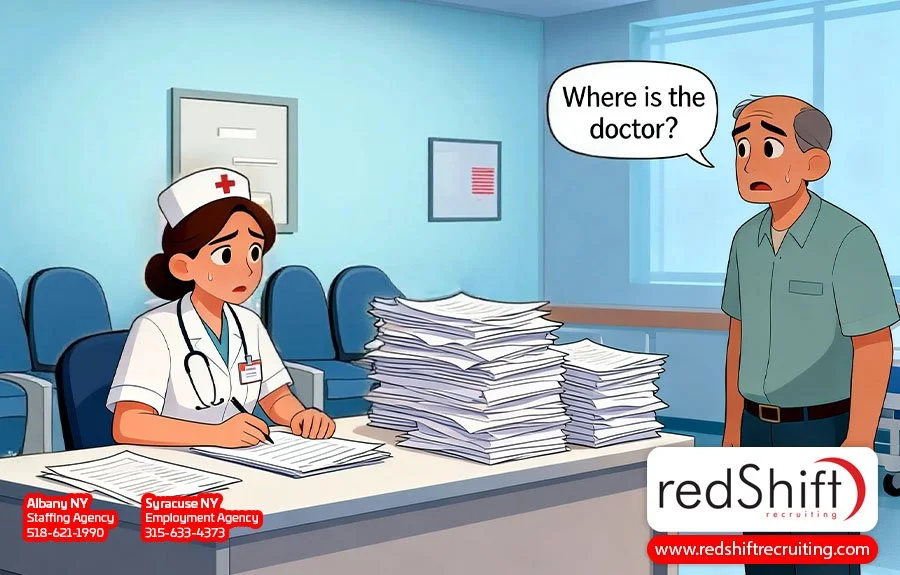
The cost of this misallocation is most visible in the industries where staffing constraints run deepest. In healthcare, the consequences of misallocated expertise are immediate and personal. Clinical staff such as nurses, physicians, and specialists are among the most extensively trained workers in any industry. Their value to patients isn't just technical knowledge; it's the emotional intelligence, situational awareness, and empathy required to understand not just a patient's condition but a patient's fears, communication needs, and context. That combination of clinical expertise and human presence is genuinely scarce and genuinely irreplaceable. Yet in understaffed healthcare environments, a significant share of their time is consumed by administrative coordination, documentation, and operational logistics—routine tasks that someone has to do, but that don't require clinical training to perform. The organization isn't just short-staffed in those moments; it's short on clinical judgment reaching the patients who need it.
The dynamic looks different in logistics and manufacturing, but the cost follows the same logic. Experienced operators and floor managers carry expertise that's difficult to quantify and easy to underestimate: the pattern recognition that identifies a process problem before it becomes a production failure, the quality instincts built from years of working in a specific environment, the ability to analyze trends, forecast demand, and develop new workers into reliable contributors. These skills don't scale with headcount or transfer quickly to someone new. They're built slowly and depleted quietly, consumed by material movement, gap-filling, and coordination work when staffing is thin. In today's AI-driven world, there's a temptation to assume that AI handles routine tasks and frees this expertise automatically. But AI absorbs process and data; it doesn't redirect human judgment. An experienced operator pulled into repetitive tasks because the floor is short-staffed isn't necessarily freed by automation—they're still not doing the work their expertise makes possible.
These two industries illustrate the issue most visibly, but the underlying dynamic runs across any business where skilled roles are absorbing work outside their core function, from professional services and office environments to education, technology, and beyond. These organizations aren't short on workers in any simple sense; they're short on the human insight, good judgment, and contextual reasoning their most experienced people provide, and the structure of the work is what's consuming it. That's a different problem than a staffing shortage, and hiring more people doesn't solve it.
The Question That Changes What's Possible
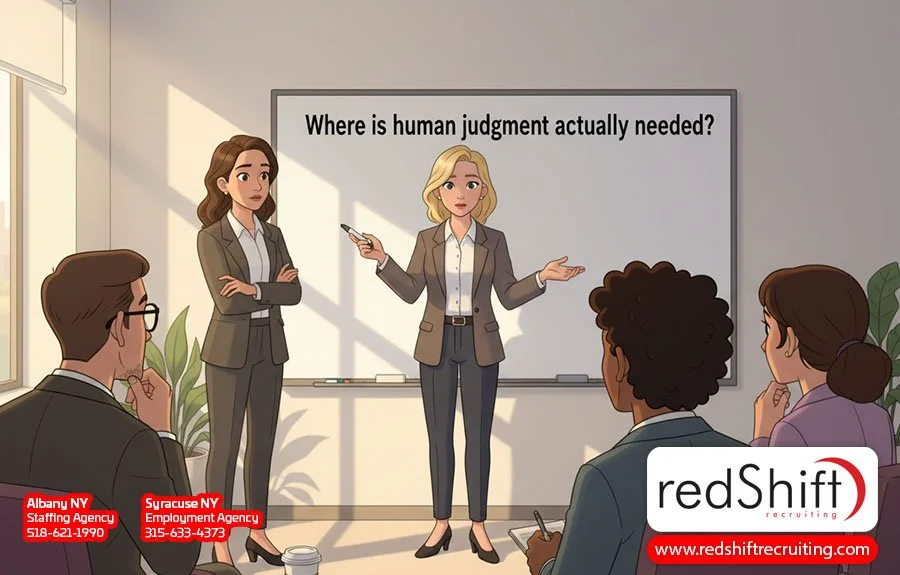
In the so-called "age of AI," the conversation about workforce constraints has largely moved between two questions: Who can we hire, and what can we automate? Both are legitimate, and both have their place. But neither gets at the more useful question: when does the work actually require human judgment and expertise, and where are those uniquely human skills being used?
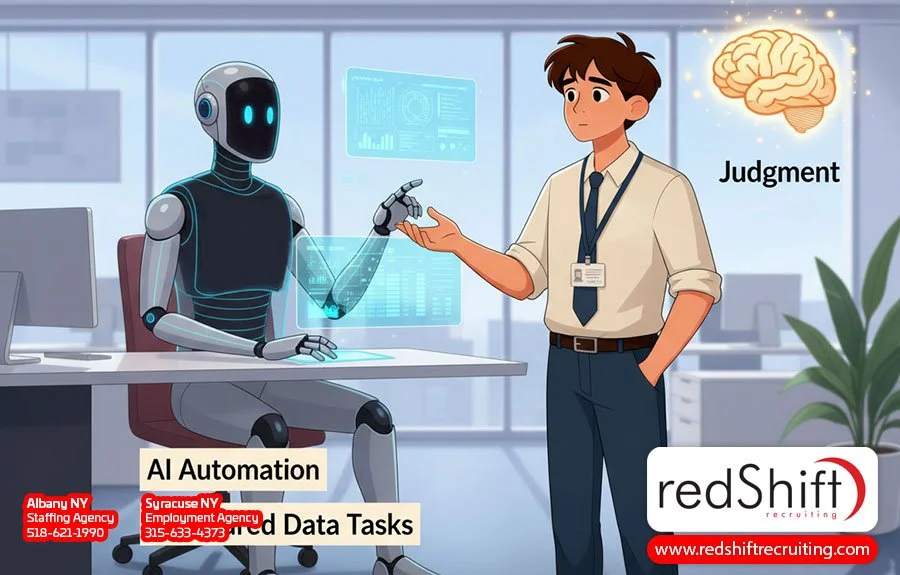
This isn't primarily a question about artificial intelligence or technology; it's a question about organizational honesty. As AI systems take on more routine tasks and process massive amounts of data at speed and scale, the human contribution that remains becomes more concentrated and more consequential. Human oversight, moral reasoning, and the kind of creativity and situational awareness that AI can't replicate don't become less important in an "AI era"—they become the thing that most needs protecting. And protecting them starts with understanding where they're actually going.
The conversation looks different by industry. In healthcare, it centers on separating clinical judgment from the administrative load that has accumulated around it; in logistics and manufacturing, on ensuring experienced operator expertise reaches the decisions and development work it's uniquely positioned to handle. Regardless of the situation, the underlying question is the same in every case: is the organization's most valuable human contribution going where it actually matters?
The real challenge isn't identifying the problem—most leaders closest to operations already see it. The difficulty lies in examining structures that have been in place for years, confronting why skilled work drifted in the first place, and addressing problems that don't lend themselves to quick fixes and that affect real people and real workflows. That conversation touches culture, priorities, and decisions about how the organization has been running. It also matters for the people doing the work, because employees whose expertise goes unused eventually stop seeing a future in a role that doesn't match their career goals.
Businesses that don’t address this issue miss a real opportunity, and the consequences accumulate. Turnover increases, service quality erodes, and the contributions hardest to replace start to disappear as a result of accumulated pressure. The organizations that retain their competitive advantage are the ones that stop just reacting to that pressure and start getting ahead of it. That's true at the organizational level, and it's equally true at a broader structural level that no single employer fully controls—one that shapes the environment every organization is operating in, whether they're paying attention to it or not.
Are You Using Your Team’s Skill Sets Effectively—Or Just Filling Gaps?
Having experienced people in place doesn’t guarantee their expertise is being used where it matters most. When skilled employees spend their time covering gaps and handling routine tasks, the work that depends on their judgment starts to slip. Looking at how your team’s skills are actually being used can reveal issues that staffing numbers alone won’t show.
Frequently Asked Questions
How Does Misallocated Human Judgment Affect Decision-Making and Business Performance?
When skilled employees spend most of their time on work that doesn't require their expertise, the impact on decision-making is direct. The analysis doesn't get done. Strategic planning gets deferred. The human oversight that would have caught a problem early doesn't happen because the person responsible was pulled elsewhere.
Organizations that consistently misdirect their best contributors find themselves reacting to problems that their expertise would have prevented, losing institutional knowledge when experienced people leave, and struggling to scale in ways that depend on judgment that simply isn't available where it's needed. Those that direct skilled expertise toward work that genuinely requires it are better positioned to make faster, more confident decisions and build the operational resilience that compounds into competitive advantage over time.
What Is Human Oversight and Why Does It Matter in an AI-Driven World?
Human oversight is the active role people play in monitoring, interpreting, and making decisions about processes and outcomes that AI systems can't fully evaluate on their own. As organizations rely more heavily on automation, its importance grows rather than shrinks.
Human judgment catches the edge case the algorithm wasn't trained for, recognizes the signal the data didn't capture, and makes the call that requires empathy, moral reasoning, or situational awareness no system can replicate. The real risk isn't that artificial intelligence makes human judgment unnecessary—it's that organizations treat AI as a substitute and discover the gap only when something goes wrong.
What Are AI Skills vs. Human Skills and Why Does the Distinction Matter?
AI skills—working effectively with artificial intelligence tools, interpreting outputs, and integrating them into workflows—are increasingly valuable. But they only create value when paired with the human capabilities AI can't replicate: critical thinking, creativity, emotional intelligence, and contextual judgment.
The ability to work alongside AI matters. So does knowing what to do when it breaks and when it's wrong, incomplete, or operating outside its training. Human leadership, from reading a room and building trust to navigating complexity and making decisions that account for what data alone can't capture, isn't peripheral to performance. As AI handles more process-driven work, these human skills are increasingly what holds everything else together.
How Does Poor Allocation of Human Skills Affect Competitive Advantage?
Competitive advantage in a constrained labor market isn't just about access to talent—it's about how well that talent is used. When experienced employees are directed toward work unrelated to their core expertise, the organization loses the decision-making frameworks, institutional knowledge, and specialized judgment they were hired to provide.
Organizations that allow this drift long enough find that the high-value work—the analysis, the research, the planning, the innovation—either doesn't get done or gets done poorly. Addressing how skilled employees are being used isn't a peripheral HR concern; it's a strategic question with direct implications for culture, performance, and long-term competitive advantage.
What Does Human Leadership Look Like in the Age of AI?
Human leadership in the age of AI is defined less by what leaders know about technology than by what they bring that technology can't. Building trust, navigating ambiguity, making judgment calls that account for context and consequence, inspiring the kind of commitment that drives genuine creativity and innovation—these are contributions no AI system replicates. As artificial intelligence takes on more analytical and process-driven work, the human dimensions of leadership become more visible and more consequential, not less.
A leader pulled consistently into coverage work and gap-filling isn't just personally overextended—the organization is losing the strategic direction, team development, and cultural continuity that only present, engaged leadership provides. In a constrained environment, that's precisely what organizations can least afford to lose.
Conclusion: Where the Real Constraint Lies
Workforce constraints get discussed primarily as a supply problem—not enough people, candidates, or capacity. That framing isn't wrong, but it's incomplete. The deeper issue for many organizations isn't just how many skilled people they have, but whether those people's human judgment, expertise, and critical thinking are going where they actually matter.
That misallocation doesn't always announce itself. It accumulates—one deferred decision, one coverage gap, one skilled employee doing work that doesn't need them—until the cost becomes visible in turnover, degraded outcomes, and an organization that's fully staffed on paper and consistently underperforming in practice. The businesses best positioned for the next decade won't just be the ones that hired well. They'll be the ones that were honest about where their best human contributions were actually going and intentional about directing them where they belong.
That's an organizational challenge. It's also a structural one, shaped by labor market conditions, pipeline gaps, and workforce dynamics that no single employer fully controls. Both dimensions matter, and both require attention that goes beyond filling roles and hoping for the best.

Article Author:
Ashley Meyer
Digital Marketing Strategist
Albany, NY