
How to Future-Proof Your Career: A Practical Self-Assessment for a Changing Job Market
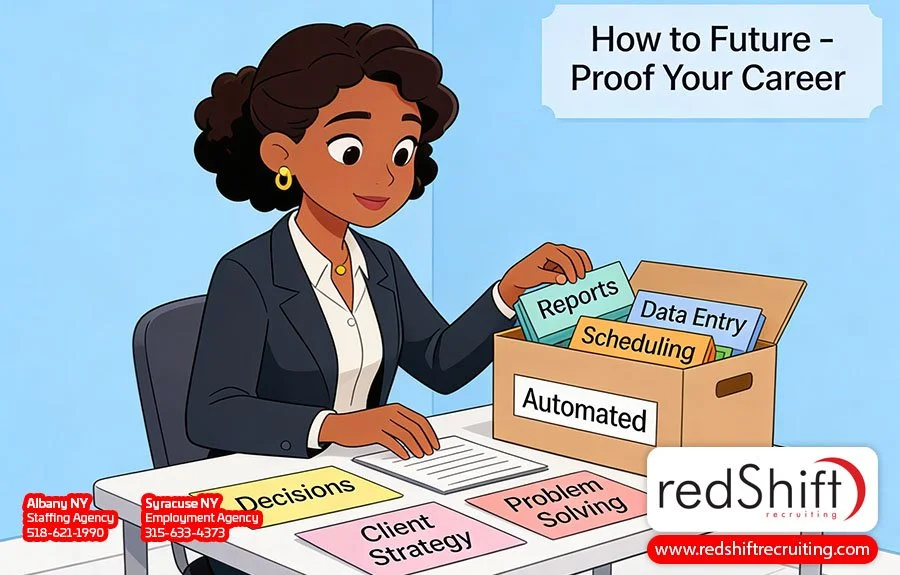
Six months ago, compiling a weekly operations report for a mid-sized company (pulling data from multiple systems, finding bottlenecks, summarizing performance metrics, and flagging recommendations for the management team) might have taken an operations analyst the better part of a day. It was real, skilled work, but it was also work that crowded out the higher-value tasks that only someone with their knowledge and experience could do. Today, AI-powered analytics tools can pull and format that data, identify patterns, and produce a draft summary in a fraction of the time. The analyst reviews the output, applies their expertise, refines the recommendations, and it's done, leaving the time they’ve saved available for other tasks. But that raises a harder question: if AI can do the work that used to define your role, where does that leave you—and how do you future-proof your career before your boss finds the answer for you?
This article is about taking practical steps to address that question: how to assess your own role honestly, identify where the real risk to job security lies, and take a proactive approach toward the work that's genuinely hard to replace.
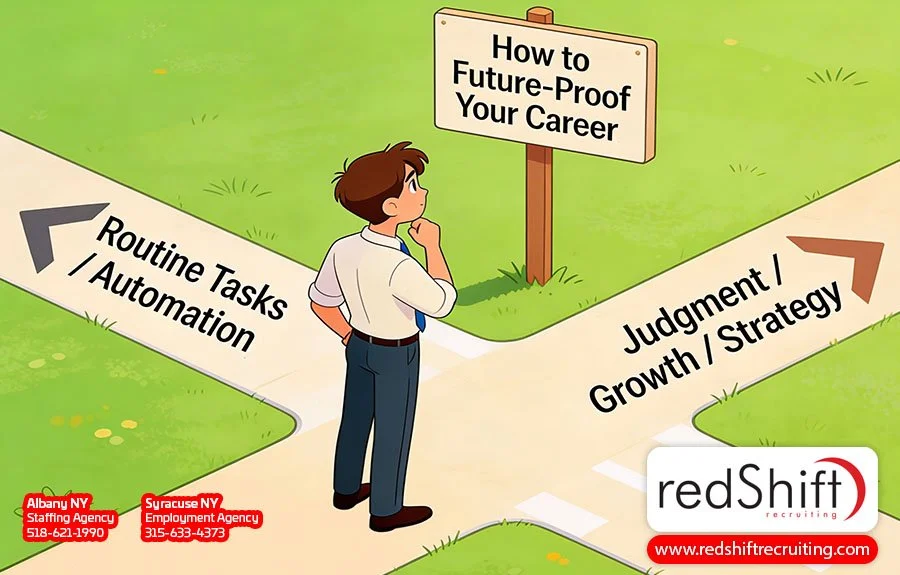
Intelligence Work and Judgment Work: Where Does Your Role Actually Fall?
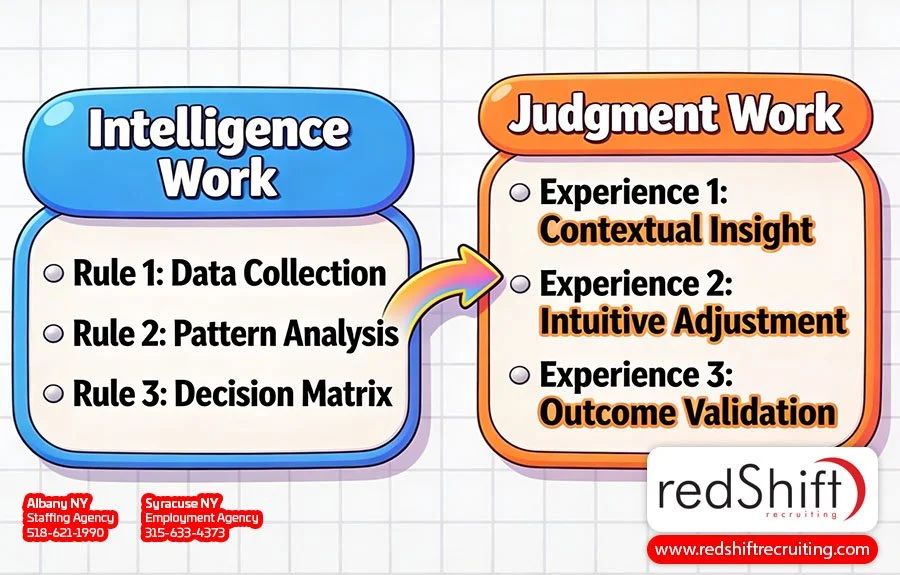
If you've read our previous piece on why human work isn't going away, you'll recognize this framework. If not, here's the short version: work broadly divides into two categories. Intelligence work follows defined rules and processes even when it's genuinely complex, whereas judgment work relies on experience, context, and the kind of accountable human decision-making that can't be systematized. For many people, the parts of their job that are primarily at risk are the intelligence-heavy ones and the parts hardest to replace are those where human judgment, relationships, and accountability are the actual product. Most roles contain both, which is exactly what makes this a useful career planning tool and not just an interesting idea.
The World Economic Forum's Future of Jobs Report 2025found that employers expect 39% of workers' core skills to change by 2030. That means that questions about job security need to look beyond jobs disappearing or new roles being added and assess how work is changing within existing roles. Two people with the same job title at different companies can sit in very different places on this spectrum depending on how their role is structured and how far automation has reached in their specific organization. "Is my job at risk?" is only part of the question. The more useful inquiry is, "What percentage of my week is intelligence work versus judgment work, and which direction is that ratio moving?"
Think of the intelligence-judgment split as a spectrum with three rough zones:
At the intelligence end sit job functions like standard medical billing and coding, procurement of routine vendor contracts, and high-volume candidate screening. Some of these tasks require real knowledge and training to perform well: medical billing is a legitimate example of genuinely complex rule-governed work. But complexity isn't the same as professional judgment. These types of tasks are automation targets not because they're easy, but because they're definable. Given sufficient data, AI models can learn the rules and execute them faster and more consistently than any human team.
At the judgment end sit roles where a specific person's trust and accountability are the actual product: crisis communication, complex negotiations, on-site trades work, clinical diagnosis, and executive decision-making, to name a few. AI tools are present even here, but they're assistants, not replacements, because ultimately a human owns the outcome.
Most of the workforce sits somewhere between these two poles. Consider financial analysis, where the model runs but the interpretation and client recommendation require judgment. Or the work of a human resources generalist, where job posting and applicant tracking are increasingly handled by technology, but a hiring decision, a sensitive termination, or a team conflict still requires a person in the room. Then there's supply chain coordination, where routing logic is automated, but managing a supplier relationship through a disruption involves variables no algorithm accounts for. The judgment portions of these roles are where human value is consolidating, and for most professionals, that's where their attention belongs.
If the majority of your week currently sits at the intelligence end of that spectrum, it's a signal that it's time to take stock of where your work is heading and think about where it goes next.
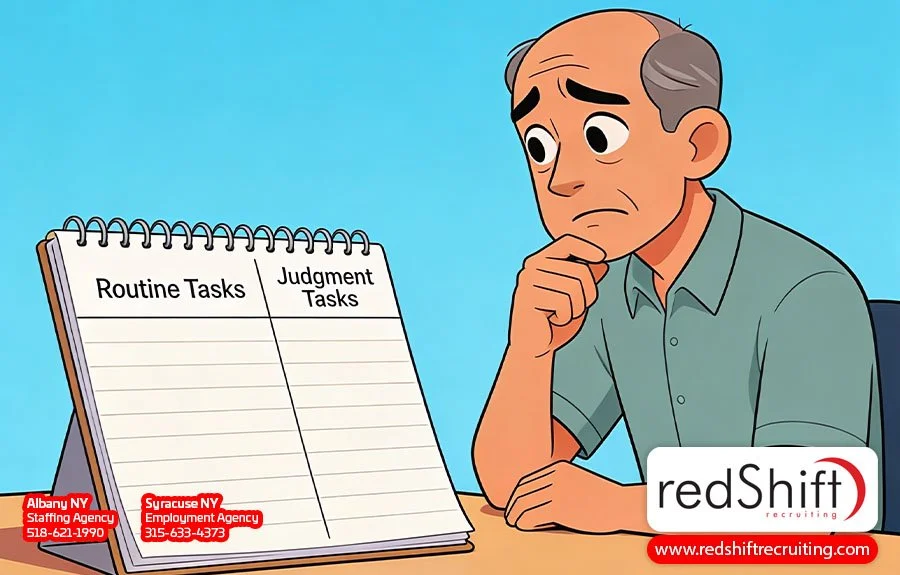
Four Questions Worth Asking About Your Own Work
The intelligence-judgment framework is only useful if you can apply it to your own work honestly. Answering the following questions can help you take a practical look at what you actually spend your time on day-to-day.
1. Consider one of your core tasks. If you wrote down every step as a set of rules, could someone follow those rules without you? If the rules themselves are the whole job with no meaningful judgment required in applying them, it's intelligence work, regardless of how complex it feels.
2. Has anyone ever asked for your judgment specifically—not just your output? "Can you run the numbers on this?" is a request for output. "What do you think we should do here?" is a request for judgment. If you can't remember the last time someone asked the second question, it's an important signal.
3. Does your work require something that isn't easily replicated by another person or by a machine? The bar here isn't whether you're the only person on earth who could do this job. It's whether you bring something to it that would take real time, effort, or relationship capital to replace. A client who would accept the same result from anyone is buying output. A client who calls you when something goes sideways is buying a relationship. This is where emotional intelligence, stakeholder management, and soft skills that don't show up cleanly on a resume become real leverage, and where the work you do gets genuinely hard to replace.
4. Would something go meaningfully wrong if the judgment component of this work were removed from the equation? Not slower or less convenient, but meaningfully wrong, specifically because no one was there to apply real expertise and make the final call. If the honest answer is no, the work is substitutable regardless of who's doing it.
Most people will find their answers split. Some tasks will clearly require human judgment; others won't. You don't have to reach a clean verdict—identify which questions you're answering yes to and build from there.
Also, keep in mind that the pace of change isn't uniform across fields. Generative AI has moved through parts of the job market (such as customer service, content generation, and basic financial analysis) faster than through others. Complex human variables, licensing requirements, and the importantance of physical presence all affect how quickly a given field shifts towards AI adoption. In some industries, the change has been dramatic in just the past year; in others, it's barely visible over several years. Knowing where your industry sits on that timeline matters as much as knowing where your role sits on the intelligence-judgment spectrum.
Practical Steps That Don't Require a Career Overhaul
Professional judgment is built by making decisions and learning from the results, maintaining business relationships, and accumulating experience over time. Future-proofing your career isn't a single pivot; it's a series of small, deliberate moves that add up over time. Here are four actionable steps you can start now:
First, be honest about where your time actually goes. Before changing anything, get a clear picture of what your week really looks like. Write down your five or six most time-consuming tasks and ask yourself: is this work I'm doing because it requires my judgment and expertise, or because it needs to get done and I happen to be the one doing it? This will help you identify which parts of your role are genuinely hard to replace and which ones aren't. Most people find the split more uneven than they expected, and that's useful information. Self-awareness is the foundation everything else builds on.
Next, make the professional judgment you're already exercising more visible. Depending on your role, you may not need to ask for additional responsibilities to demonstrate professional judgment, but you do need to make what you're already doing clearer to the people above you. When presenting your manager with your work, walk them through your reasoning, not just your conclusion. When you flag a problem early or catch something that would have caused issues downstream, say so explicitly rather than quietly fixing it. And when you make a judgment call, be able to explain why. These are things any employee can do at any level, and employers notice the difference between someone who just produces results without being able to explain their thinking and someone who understands what they're doing and why.
Focus on getting exposure, not promotions. For people earlier in their careers, or in roles where the judgment-heavy work sits above their current level, the most practical move is a direct conversation with your manager framed around what you can contribute, not what you want to receive. "I'd like to better understand how these decisions get made so I can support that work more effectively" is a reasonable professional request that leaders respond to far better than a general ask for more responsibility or a promotion. Ask to be included in a client conversation, observe a senior decision, or assist on a project that runs above your usual scope. Access to judgment-heavy work often comes through proximity before it comes through a title.
Finally, build working knowledge of the AI tools in your field. Developing genuine familiarity with the artificial intelligence tools relevant to your role is one of the most practical new skills you can invest in right now. That means getting enough hands-on experience to know what the tools do well, where they fall short, and when to question their output. The ability to critically evaluate AI-generated work is becoming increasingly valuable across nearly every profession. Whether through formal courses or self-motivated experimentation, continuous learning is key to staying relevant in any field. AI tools are reshaping how work gets done across nearly every industry, which means understanding them is becoming as professionally essential as knowing the core tools of your trade.
What to Do When Your Role Has a Ceiling
Sometimes the issue isn't knowing what to do. It's simply that the judgment work in your organization isn't accessible from where you sit. Some companies are structured to keep complex decision-making centralized in a small number of senior positions, with no clear path from the entry- or mid-level to the other side.
If you've had the conversations and pursued the opportunities and the answer keeps coming back the same, look first for judgment-heavy work that nobody officially owns—the stalled cross-functional project, the client relationship that needs attention, or the new hire who needs a mentor. These are opportunities to build visible accomplishments and demonstrate capabilities before you have the title that grants them officially. "Visible" is the key word: make sure the right people can see what you're contributing, or it won't register as initiative.
If that doesn't move the needle either, it's worth factoring the structure of your organization into your long-term career planning. Recognizing when a ceiling is real is a sign of professional maturity, not defeat, and it may mean it's time to look for new opportunities elsewhere.
Future-Proofing Isn't a Destination
Finally, keep in mind that the intelligence/judgment line isn't fixed. As AI accumulates domain-specific data and capabilities, it begins absorbing work that previously required genuine human expertise, and it's happening at different rates across industries. For example, AI-assisted diagnostics have already taken over significant portions of medical imaging—tasks that required years of specialist training to perform manually a decade ago—though clinical judgment and sign-off remain with the radiologist. The same shift is happening more gradually in financial advisory, HR consulting, and marketing strategy. Knowing what's going on in your field is critical to understanding how your role may evolve and how quickly the ground is shifting beneath you.
There is no plan that permanently future-proofs a career, and your goal shouldn't be to find a role AI can never touch. Focus instead on the capabilities that compound in ways AI can't easily replicate: deep domain expertise built through a commitment to lifelong learning, and trusted relationships nurtured through consistency, attention, and accountability. The earlier you start building both, the harder you become to displace. For most people, the right moves are within their current field, but it's worth being honest that if your industry is shifting faster than individual adaptation can match, a broader pivot may be the more practical path than optimizing when your opportunities are shrinking.
So ultimately, when assessing how to future-proof your career, the most useful question isn't, "Is my job being automated?" It's, "Am I actively building the skills and judgment that stay ahead of what new technologies can absorb next—or am I just waiting to find out what happens?" Workers making intentional choices in response to that question are already ahead of most.
Frequently Asked Questions
My Company Just Deployed an AI Tool That Handles Most of My Current Work. What Should I Do Now?
Resist the urge to treat this as purely a threat. In many cases, AI handling the repetitive tasks in your role is an opening as much as a loss—it frees time for the work that actually requires you. The practical question is whether your organization is structured to let you use that time well. Have an explicit conversation with your manager about what the role is expected to look like in twelve months. If the answer is unclear, that's important information. If the answer is "less of everything," that's a signal worth acting on sooner rather than later.
I'm Early in My Career and Most of My Work Is Intelligence-Heavy. Is That a Problem?
It's not a problem, but it does mean you may be working with a shorter timeline. Entry-level roles have always been process-heavy by design, allowing you to learn the work by doing the foundational parts of it first. What's changed is that the window between learning the intelligence work and building toward the judgment layer is narrowing. The practical response is to be intentional earlier: look for moments in your current role that require expertise rather than procedure; find a mentor and actively seek their advice on how to get exposure to judgment-heavy work before you'd normally encounter it; research where the judgment work lives in your field before you need to make a move; and start building genuine familiarity with the AI tools in your field now rather than later. Finally, use your peers as a benchmark—the ones moving fastest are usually the ones actively seeking experience, not waiting for it.
What if I'm in a Creative Field? I Thought That Work Was Judgment-Heavy, But AI Seems To Be Making Inroads There Too.
It is, and creative fields are a useful test case for the limits of the intelligence/judgment distinction. AI has absorbed a meaningful portion of what looked like creative judgment, such as visual design to spec, content generation from briefs, and templated copywriting, because that work turned out to be more rule-governed than it appeared. The durable line in creative work isn't between "creative" and "non-creative." It's between work where your perspective, accountability, and relationship to the client genuinely shape the outcome, and work where the deliverable is what matters regardless of who produced it. Innovative thinking, original concept development, and the trusted creative relationship are all examples of judgment work in these fields. Producing assets to a defined spec is increasingly intelligence work, whatever the medium.
Is Building Toward Judgment-Heavy Work Only Realistic if I Want to Move Into Management?
No, management is one path, but a senior individual contributor who is the institutional memory of a process, the person leaders go to when the standard approach isn't working, or the trusted first call when something goes sideways is doing deeply judgment-heavy work without managing anyone. The goal isn't holding a specific title or having a direct report; it's to become the person whose confidence, expertise, and insight make them genuinely difficult to replace. That path is available in almost every field, regardless of whether you ever want to lead a team.
How Do I Talk About This Kind of Career Thinking in an Interview Without Sounding Like I'm Just Worried About Job Security?
Frame it as professional development, not risk management. HR professionals and hiring managers respond well to candidates who can articulate where their field is moving and what skills are in high demand—this signals self-awareness and initiative, both of which leaders associate with long-term success in a role. For example, "I've been deliberately building the advisory side of my work because that's where I see the most value and the most opportunity to create real impact" is a stronger answer than "I just want to keep growing in my career" when asked about long-term career goals. It also positions your education and experience as intentional rather than reactive, which is exactly how you want to come across.
Conclusion: Get Started Before You Have To
The intelligence/judgment framework is only useful if you actually apply it to your own work. The self-diagnosis questions, the direction your role is moving, and your access to judgment-heavy work are things only you can assess, and the workers who assess them honestly and act on what they find are the ones best positioned to stay competitive as new technologies continue to develop. There's no single credential, title, or plan that guarantees success, but deliberate, incremental moves toward the judgment end of your field are the best place to start. Your field will keep evolving, the line between intelligence and judgment will keep moving, and the specific moves that keep you relevant will shift with it. The best time to make those moves is before the question becomes urgent—and for most people reading this, that time is now.

Article Author:
Ashley Meyer
Digital Marketing Strategist
Albany, NY