
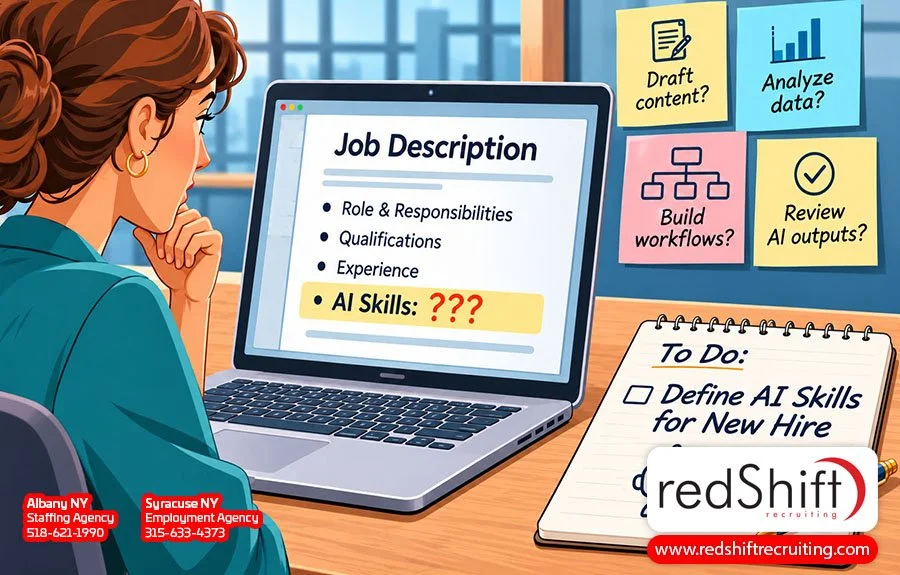
Artificial intelligence is no longer confined to the tech department. From marketing and design to administration and project management, growing AI adoption means more employers are expecting new hires to work effectively with AI technologies in their day-to-day tasks. That growing demand is showing up in job ads too: according to LinkedIn data published in October 2026, the share of job postings requiring AI literacy skills rose roughly 65% over the previous 12 months.
But what does “AI skills” actually mean? Job posts tend to use phrases like “familiarity with AI tools,” “AI fluency,” or “AI proficiency,” without explaining how employees will be expected to use those skills. Just as “strong communication skills” could mean persuasion for a sales rep, clear handoffs for a nurse, or readable documentation for an engineer, “AI skills” can mean completely different things in different positions.
Knowing you want someone who can use AI is one thing; defining exactly what they'll need to do with it is another. To identify the right AI skills for your next hire, you'll need to look at the work involved, how much the job depends on AI, how independently the employee will use it, and what happens if something goes wrong.
Why Are “AI Skills” Too Broad to Be a Hiring Requirement?
“AI skills” can describe anything from basic familiarity with AI tools to the technical expertise needed to build and manage AI systems. Even employers using the same terms may have widely varying expectations. One might consider someone AI fluent if they're comfortable with common tools, while another expects someone who can design complex AI-supported workflows from scratch.
A marketing professional drafting campaigns, an accountant checking flagged anomalies, and an IT professional triaging support tickets may all use AI, but the skills each job requires are very different. A candidate may have significant AI experience in one setting but still lack the capabilities your role requires.
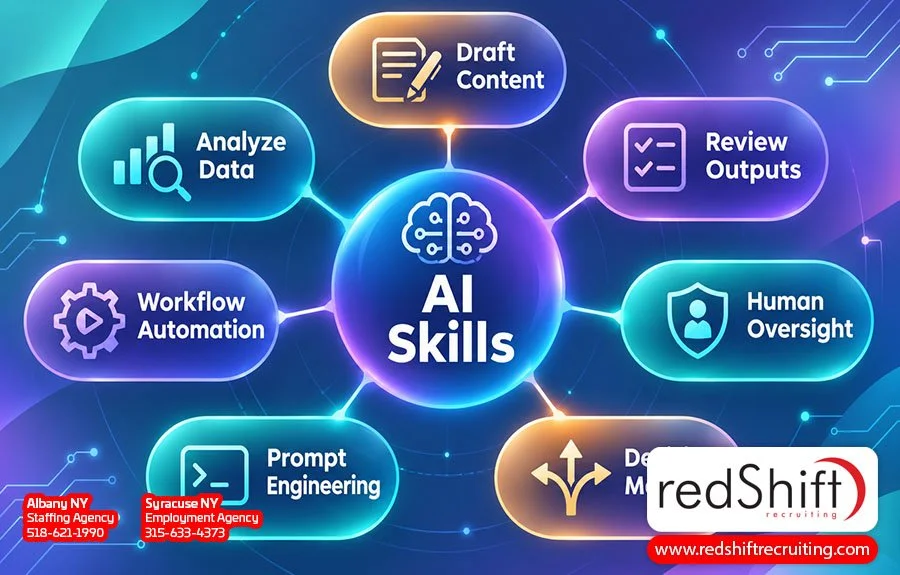
At a basic level, AI literacy involves understanding what the technology can and can't do, when it's appropriate to use, and how to evaluate its results. Beyond that foundation, the skills needed depend on what the employee will actually do:
Routine AI use: Someone using generative AI for drafting emails or summarizing documents may need to know how to give clear instructions, provide relevant context, and review the results for accuracy and appropriateness.
Evaluating AI-generated work: An accountant using AI to flag unusual transactions needs the professional knowledge and judgment to distinguish a genuine concern from an incorrect or misleading result.
Automating workflows: Someone developing AI-supported processes may need to understand how different tools and systems interact, configure workflows, handle exceptions, and recognize when human review is necessary.
More specialized positions may involve building AI agents, developing machine learning models, or helping integrate AI systems into existing operations, and hiring for those technical specialties is an entirely separate search.
Simply listing “AI skills” in a job description doesn't tell candidates which of these capabilities the position actually requires. This lack of clarity can complicate an already challenging hiring process, leaving job seekers unsure about the requirements and employers with more unqualified applicants.
Identifying the AI Skills a Role Actually Needs
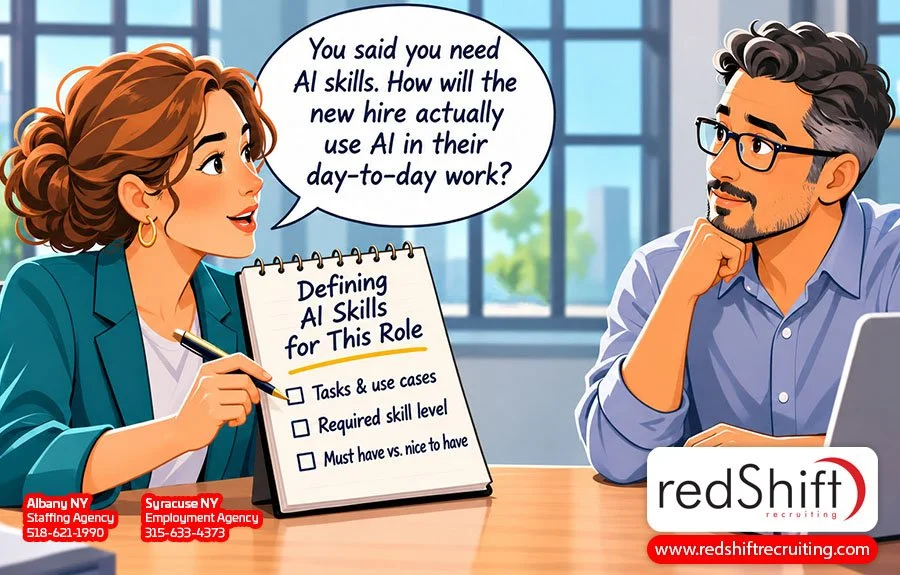
Defining the right AI requirements starts with understanding where AI fits into the day-to-day work. Recruiters and hiring managers who aren't familiar with the work firsthand should talk to the people who are. Supervisors and team members can help clarify what the new hire will actually be expected to do with AI and which skills that work requires.
Even if you know the role well, take time to spell out those expectations rather than relying on a generic “AI skills” bullet point. This kind of job analysis gives hiring teams clearer criteria for assessing candidates, while giving job seekers enough information to judge whether they're qualified for a particular role. For positions where the use of AI raises significant security, legal, or operational concerns, you may also need input from IT, security, or legal.
The following four questions can help you identify and clearly define the skills your next hire needs.
1. What Will AI Actually Help This Person Do?
A requirement like “experience using AI to improve productivity” tells candidates almost nothing. Be specific; will the employee:
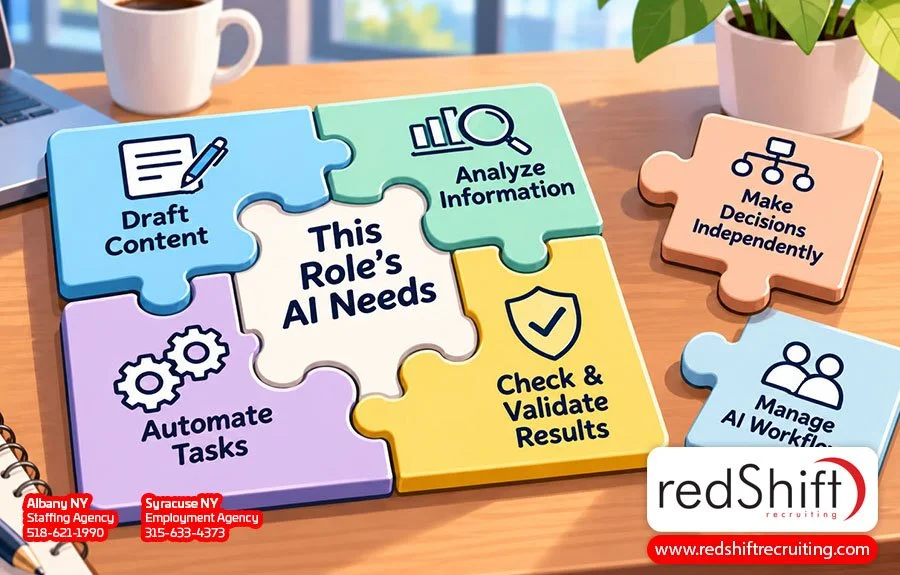
Analyze data to find patterns or trends?
Draft, revise, or summarize written material?
Run or maintain existing workflow automation?
Support research, problem solving, or decision making?
Identify opportunities to streamline workflows?
Focus on real outcomes: what the person will produce, improve, or decide, rather than which tools they’ve touched. Consider two positions in a customer service department. A customer service representative uses an approved AI tool to draft routine email replies, while a customer experience analyst uses AI for data analysis, identifying patterns in customer conversations and recommending improvements to departmental workflows. Both positions might list AI fluency as a requirement, but the representative needs basic prompting, written communication, and editing skills, while the analyst needs stronger data analysis and interpretation skills to turn findings into recommendations that inform business decisions.
2. How Central Is AI to the Role?
Ask what would happen if the employee couldn’t do the AI-related part of the job. If they could still handle most of their responsibilities, AI is a supporting tool. If a gap would stall a large share of the work, it’s central.
How often someone uses AI doesn't necessarily tell you how much their role depends on it. An employee might use AI daily for minor tasks, while another relies on it less frequently for a critical responsibility.
3. How Much Autonomy Will the Employee Have?
Following an established workflow is very different from deciding how that workflow should run. Will the employee:
Follow documented procedures with approved tools?
Decide when and how to use AI for a given task?
Choose tools, compare alternatives, or troubleshoot problems?
Design new workflows or change how the work gets done?
Someone following established procedures may mainly need to understand the tools, follow instructions, exercise good judgment, and recognize when something is wrong. Other employees may be expected to decide how to incorporate AI into their work, experiment with different approaches, or improve existing processes. Positions responsible for evaluating AI tools for a department, developing complex workflows, or determining how the organization should adopt AI may require more extensive experience with automation, troubleshooting, and process design.
4. What Happens If the AI Is Wrong?
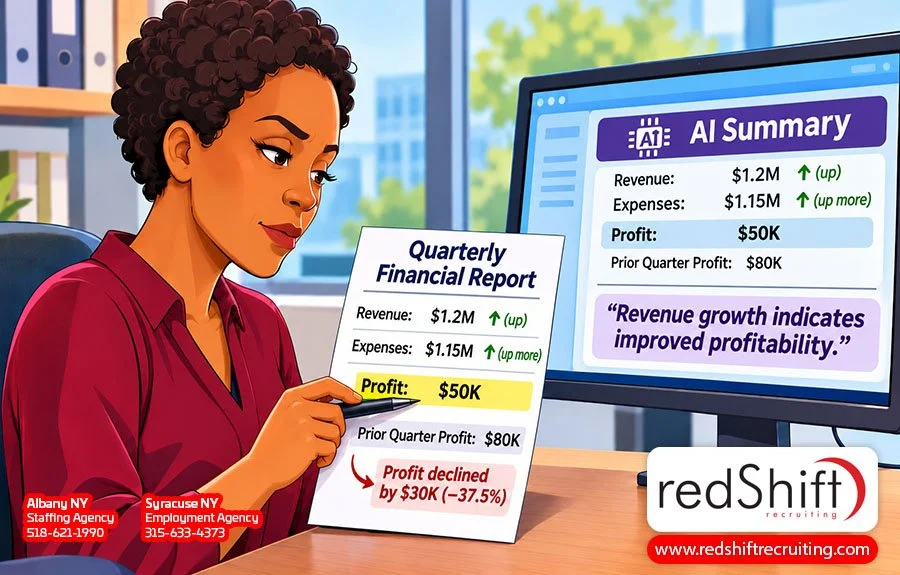
Human oversight is an important part of responsible AI use, but it's only effective when the employee knows what to look for. Getting a response from an AI tool is one skill; having the professional knowledge to evaluate AI outputs, catch mistakes, and apply human judgment is another. That includes knowing when AI shouldn't be used at all.
The consequences of mistakes can vary widely. An inaccurate internal draft might create extra work, while errors in financial reporting, safety procedures, or the handling of confidential data can have much more serious consequences. For example, someone reviewing AI-assisted financial reports needs enough accounting knowledge to recognize misleading conclusions or serious errors, not just experience using the AI tool. The higher the stakes, the more important it is to make sure the employee has the expertise to recognize and address problems before they cause harm.
Putting the Analysis Together
To see how the four questions work together, consider a company hiring a marketing coordinator. The position involves managing social media, preparing campaign materials, tracking performance, and supporting other marketing activities. The company also expects the employee to use AI to help with certain tasks.
Here's how the employer might assess the role's AI requirements:
| Question | Marketing Coordinator |
|---|---|
| What will AI help them do? | Draft and revise social media content, adapt campaign messaging, and summarize performance reports |
| How central is AI to the role? | AI supports routine tasks, but most responsibilities can still be performed without it |
| How much autonomy will they have? | Uses approved tools, decides how to incorporate them into daily tasks, and adjusts their approach as needed; isn't responsible for developing department-wide AI processes |
| What happens if AI is wrong? | Inaccurate or inappropriate content could affect the company's credibility; the employee must recognize problems and correct them before publication |
Based on these answers, the employer might prioritize marketing knowledge, strong writing skills, and the ability to use AI to draft and revise content while catching errors, improving weak writing, and making sure the results fit the company's brand. The employee should also be comfortable deciding how to use AI tools effectively in their daily work, but experience building complex automated workflows wouldn't be necessary for the responsibilities described.
Deciding What Candidates Must Know Before Hiring
Once you know what the role needs, the next step is determining which skills candidates must have at the time of hire. Don't assume the requirements from the last time you filled the position still apply; AI tools and job responsibilities may have changed. A good starting point is to consider what would be harder or slower to develop after hiring: the professional expertise, the AI capabilities, or both.
Being comfortable with AI doesn't make someone qualified to do the underlying work. An accountant still needs accounting knowledge, and a marketer needs to understand audiences. That human expertise, along with critical thinking and soft skills like communication, gives professionals the ability to judge AI outputs and explain their decisions. But the reverse is also true: an experienced professional isn't automatically skilled at using AI.
Determine What You Can Teach on the Job
Before assuming new hires can pick up AI skills after they start, ask:
Time: How quickly must the employee work independently?
Complexity: Can the skill be learned through straightforward instruction, or does it take extensive practice?
Support: Will someone be available to train, supervise, and give feedback?
Consequences: Can the employee practice without creating serious risks?
If you have established tools, clear procedures, and people available to help, you can often hire for transferable skills and teach the rest. If someone has to work independently right away, introduce unfamiliar tools, or build processes nobody else understands, you’ll likely need someone who already has that experience.
Look Beyond Experience With Specific AI Tools
Someone with relevant professional experience and a solid grasp of comparable tools can often learn your platform quickly. With ongoing AI developments and new technologies entering the workplace, the ability to learn unfamiliar tools can be just as valuable as experience with a particular platform.
Prompting follows a similar pattern. A candidate’s prompt technique, such as giving clear context and refining results, usually carries over between tools, though more complex prompt engineering for specialized workflows can take considerable practice.
Experience with your exact platform may be important if the system is highly specialized, the work depends on detailed knowledge of its features, or the employee needs to be productive immediately. Otherwise, be careful about requiring years of experience with relatively new applications. Someone who's worked with comparable tools may be just as qualified, and a rigid requirement could screen out strong candidates.
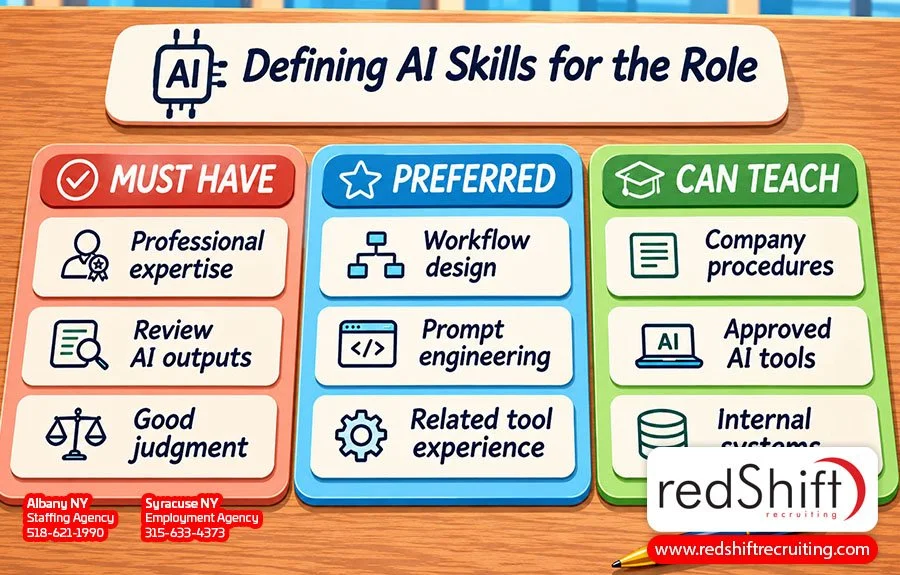
Sort AI Skills Into Must-Have, Preferred, and Teachable
Before you finalize the job description, sort the AI-related qualifications into three groups:
Must have: Skills the employee needs to perform essential responsibilities within the required timeframe.
Preferred: Experience that would help the employee become productive sooner or take on more, but isn’t essential.
Can teach: Skills, tools, or procedures the employee will need but can realistically learn after being hired.
The line between preferred and teachable is easy to blur. A preferred skill may give candidates a competitive advantage, but isn’t something every employee needs. A teachable skill is required for the job, but prior experience isn’t required because you’ll provide training.
These distinctions help keep your hiring process focused on the qualifications that matter most, from writing the job description to evaluating applicants.
Frequently Asked Questions
How Do You Put AI Skills in a Job Description?
Describe what the employee will actually need to accomplish with AI and how independently they’ll work. Instead of asking for general “AI proficiency,” specify whether the role involves using approved tools for routine tasks, evaluating AI-generated results, or designing automated workflows.
For example, a job description for a marketing role might require the “ability to use AI tools to draft and revise marketing content, check results for accuracy and brand consistency, and make necessary edits before publication.”
List must-have qualifications clearly, but don't make experience with tools you're prepared to teach a condition of hiring.
Do You Need to Hire an AI Specialist?
Not necessarily. Many jobs involve using AI within existing professional responsibilities, not building or maintaining AI systems. More complex work, such as developing advanced automated workflows or integrating AI into existing business processes, may require specialized expertise, but that doesn't always mean hiring an AI developer or AI engineer. Depending on the responsibilities, a marketing automation specialist or business process automation specialist with advanced AI skills may be just as qualified. Developing custom AI applications, on the other hand, may require software engineering or more specialized technical expertise. Focus on the work the employee will perform and the skills needed to do it, rather than assuming every advanced AI-related responsibility requires a dedicated AI specialist.
Should You Require AI Certifications or Formal Training?
Certifications and training programs can help people become familiar with particular tools, concepts, and techniques. They can also introduce or reinforce ethical AI principles, such as data privacy, recognizing bias, and knowing when human oversight is necessary. Training can help employees in both junior and senior roles, whether they’re learning AI tools for the first time or building the judgment to evaluate AI-assisted work. But completing a program doesn't prove someone has the professional judgment and human skills to apply that knowledge effectively on the job.
Before making a credential mandatory, ask whether it covers knowledge the position truly needs, or whether candidates could bring equivalent qualifications through work experience, independent learning, or relevant projects. Require formal credentials when there’s a clear job-related reason, not as a general stand-in for AI expertise.
How Can You Tell Whether a Candidate Actually Has the AI Skills You Need?
Listing ChatGPT or Claude on a resume doesn’t show someone can use it well in your workplace. Hearing how a candidate used AI on a real project is more revealing, especially when they can demonstrate AI skills by explaining what they accomplished, the decisions they made, and how they handled problems. Use relevant interview questions and follow-ups to have a real conversation about their experience and whether it fits your needs. For example, ask candidates to walk through a recent task, explain how they checked the results, and describe any steps they took to protect sensitive information.
Conclusion: Define the Skills, Not Just the Label
Simply listing “AI skills” as a requirement doesn't tell candidates what they need to know or hiring managers what to look for.
To define those skills, consider what the person will use AI to accomplish, how central it is to the work, how independently they’ll use it, and what’s at stake if something goes wrong. Then decide which AI capabilities a new hire should have and which you can reasonably teach.
The clearer you are about the requirements, the easier it becomes to identify and attract candidates with the skills the job actually needs.

Article Author:
Ashley Meyer
Digital Marketing Strategist
Albany, NY