
How to Hire AI Operators: A Practical Guide
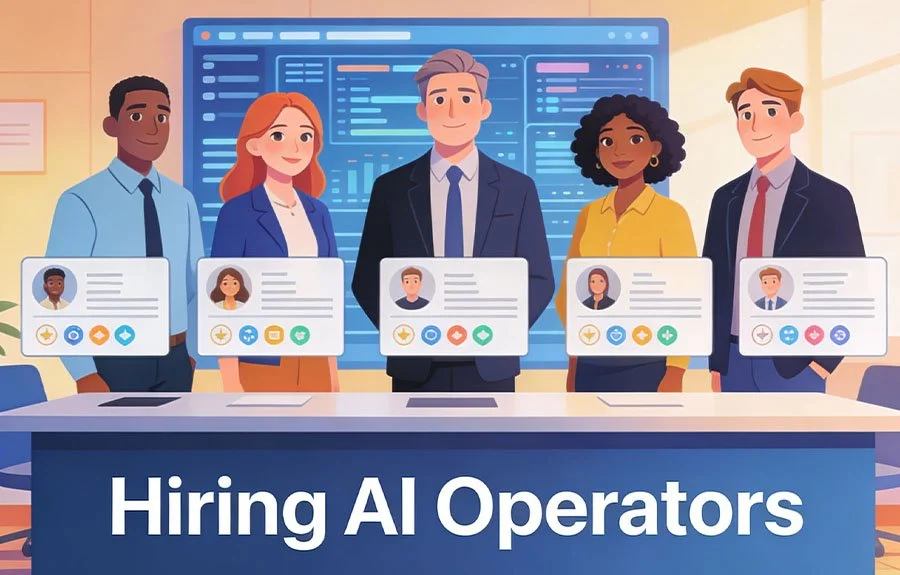
As more organizations invest in AI tools and AI systems, they often overlook the people responsible for supervising them. With AI increasingly embedded in everyday business processes, small mistakes can snowball quickly before anyone realizes there’s a problem, making the right staff just as critical as the right technology.
AI operators fill this gap, overseeing how AI is used in real workflows by interpreting outputs, questioning results, and stepping in when automation goes off track. In some environments, that means supervising systems made up of multiple AI agents working together. In others, it means monitoring individual AI tools embedded in business processes. In both cases, the role is the same: making sure automated systems behave as intended and intervening when they don’t.
In How to Hire AI Operators, we’ll walk through practical guidance for employers on how to identify, evaluate, and hire the people your business needs to support responsible, reliable AI use. As more organizations depend on AI to make informed decisions, the need for human judgment, context, and accountability has never been greater.
Why Hiring AI Operators Like Traditional Tech Roles Fails
As organizations expand their use of AI technology and start adopting AI across core business processes, many fall back on familiar hiring instincts—searching for the top AI developers, the best AI engineers, or other skilled technical specialists to “own” the work. That approach makes sense for building or refining an AI solution, but it often leads to mismatches when the real need is someone who can oversee how AI behaves once it’s operating inside the business.
AI operators (also called AI orchestrators) are not the people designing AI models, building out machine learning algorithms, or optimizing deep learning architectures. That’s the work of the AI engineers and artificial intelligence developers—professionals whose strengths lie in creation and performance tuning. AI operators, by contrast, focus on what happens after those systems are deployed: how outputs are used, how decisions move downstream, and how humans step in when automation drifts off course. If the engineers build the engine, AI operators are the ones watching the dashboard and the road ahead.
Think of this role as sitting at the intersection of people, workflows, and technology. Strong operators understand how AI systems and AI tools generate results, how teams consume those results, and how to intervene when something doesn’t look right. They don’t always need advanced technical expertise, but they do need strong AI skills grounded in practical experience, allowing them to recognize when machine learning models behave unpredictably, when a generative AI system overstates its confidence, or when a recommendation doesn’t match the situation at hand. In environments where companies implement AI agents or maintain systems with minimal human input, this oversight becomes even more important.
Because the role depends so heavily on judgment and contextual decision-making, hiring managers evaluating AI talent must shift away from the traditional emphasis on strong technical skills alone. The strongest AI operators often come from roles where judgment, communication, and context carry more weight than coding depth. They need enough knowledge to understand the behavior of AI capabilities, but more importantly, they must know when to ask questions and escalate concerns. Unlike an in-house AI engineer or AI agent developer, an operator’s main responsibility isn’t to create or refine systems—it’s to ensure those systems behave responsibly once they’re part of daily operations.
This is why hiring solely for technical strength can lead to disappointing outcomes. Highly technical candidates may focus on optimizing performance metrics rather than understanding how AI-driven decisions affect people, customers, or compliance. They may overlook subtle risks, especially in workflows involving sensitive data handling or regulatory oversight. Failures often stem not from poor candidates, but from a misalignment in the hiring process—the organization thinks it’s hiring someone to build, when what it really needs is someone to watch closely, question thoughtfully, and intervene confidently.
When organizations recognize this distinction, they reduce the likelihood of mis-hiring and create a foundation for responsible AI practices, smoother AI initiatives, and better long-term outcomes from their AI investments.
The term AI operator can also refer to an AI system that monitors, manages, and coordinates other AI tools and automated workflows. To learn more about how AI operators work at the system level, see our related article.
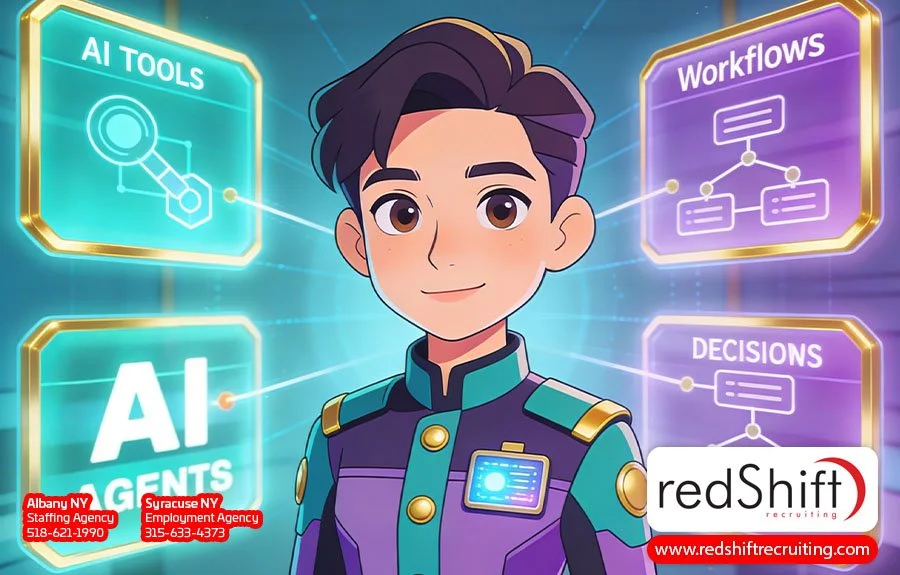
Core Skills to Look for When Hiring AI Operators
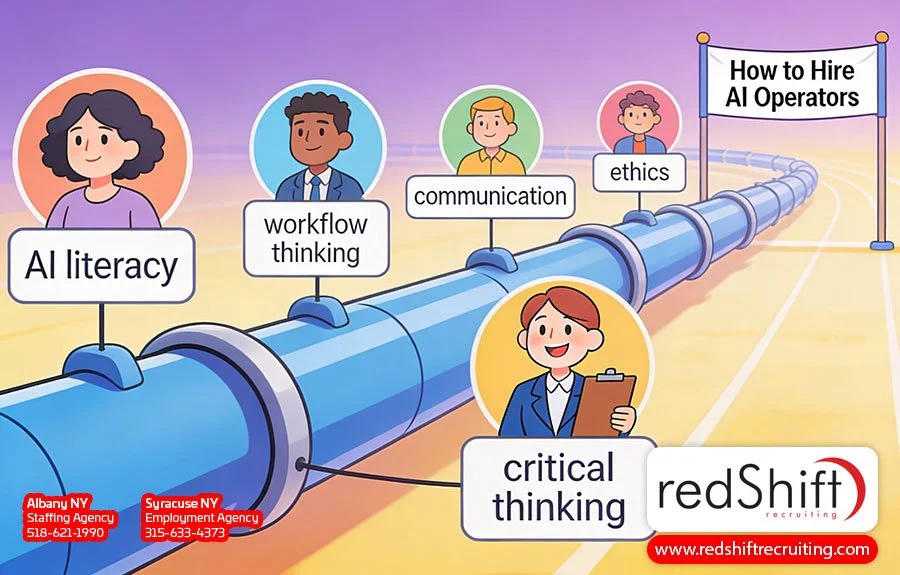
Hiring AI operators isn’t about finding the deepest technical background or the most advanced coding skills. It’s about identifying people who can operate at the intersection of business processes, automation, and human judgment—roles where soft skills often matter more than technical depth. Many organizations assume they need to hire AI developers or engineers for this work, but the skills that make someone the best AI developer are not the same skills that make a strong AI operator. The following capabilities consistently distinguish candidates who can support responsible, reliable AI use.
AI Literacy (Interpretation, Not Engineering)
AI operators don’t need to build machine learning models, work within AI frameworks, or deploy cloud infrastructure. But they do need to understand how modern AI systems behave in real-world conditions. That includes spotting situations where large language models or generative AI provide confident but incorrect answers, recognizing when natural language processing tools misinterpret intent, and understanding how outputs change as data or context shifts.
Strong operators are comfortable questioning results, identifying inconsistencies, and pushing back on recommendations that don’t align with the scenario at hand. They keep an eye on how AI performance drifts over time and how updates affect downstream work, and they play a key role in maintaining AI systems by providing the human judgment needed to catch issues early. This practical literacy—not engineering skill—is what allows them to support responsible AI use on a larger scale.
Process & Workflow Thinking
Effective AI operators understand how technology fits into the broader workflow. They can see where automation accelerates the process and where it creates new potential failure points. When companies implement AI agents or introduce new automated steps, strong operators anticipate handoff issues, edge cases, and downstream impacts.
Because AI often touches multiple teams, these operators also understand how outputs move through cross-functional teams and how small inconsistencies can snowball into operational problems. Rather than thinking in terms of isolated tasks, they understand how AI-driven decisions ripple across systems, people, and outcomes—an essential capability for organizations adopting AI in complex environments.
Critical Thinking & Judgment
AI operators frequently make decisions when outputs conflict, lack clarity, or raise concerns. This is where judgment matters far more than speed or technical depth. The strongest candidates know when to intervene, when to escalate, and when human review is essential. They’re comfortable operating in gray areas—balancing efficiency with accuracy, and recognizing when a system needs oversight even if the metrics look good.
This kind of reasoning is difficult to automate and is more aligned with operators than with artificial intelligence engineers, who are trained to improve performance rather than question it. In environments where systems operate with minimal human input, the ability to slow down, reassess, and understand context becomes a key safeguard.
Communication & Collaboration
Because AI touches many parts of the organization, AI operators must collaborate effectively with hiring managers, data teams, compliance experts, and operational leaders. They often act as translators between technical and non-technical groups, explaining AI-driven outcomes, documenting exceptions, and raising concerns in plain language.
This communication skill becomes especially important in workflows involving data scientists, machine learning specialists, or artificial intelligence engineers, where misunderstandings can lead to gaps in accountability. Clear communication ensures that issues are identified early, well before small errors grow into larger risks.
Risk Awareness & Ethics
Strong operators understand that AI introduces new types of risk, including bias, compliance exposure, and data sensitivity. They are willing to slow or stop automated workflows when something doesn’t look right—even when there’s pressure to move quickly. They know when to escalate concerns and understand that accountability doesn’t disappear just because a system is automated.
Organizations focused on ethical AI development and responsible AI practices rely on operators to spot early warning signs and act decisively. Their situational awareness protects both outcomes and organizational reputation, ultimately supporting long-term success as companies continue leveraging AI across the business.
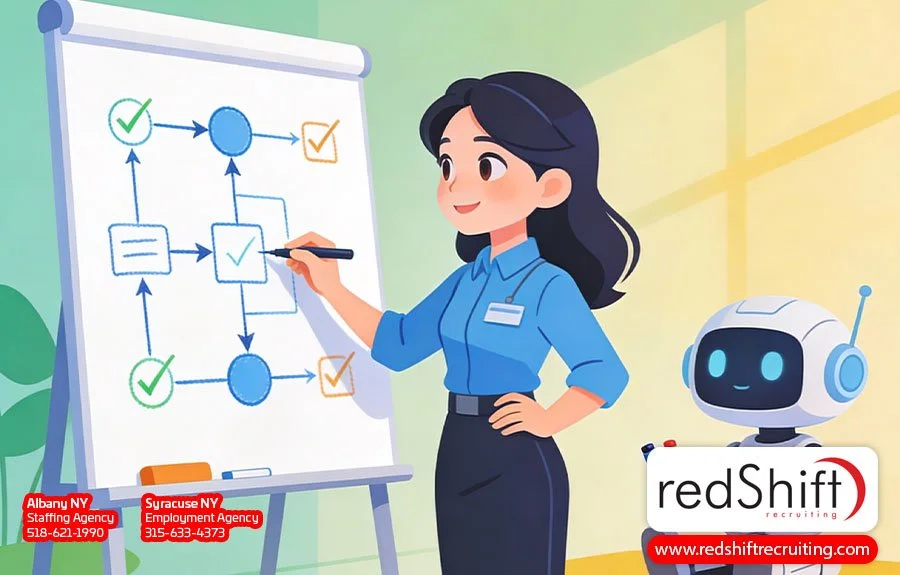
Where to Find AI Operator Talent
One of the biggest hiring mistakes most companies make is searching for “AI Operator” as an official job title. Because this is still an emerging role, strong candidates rarely label themselves this way. Traditional searches on job boards often miss the mark entirely, either highlighting people with heavy engineering backgrounds or overlooking candidates who actually have the right mix of judgment, context, and practical experience.
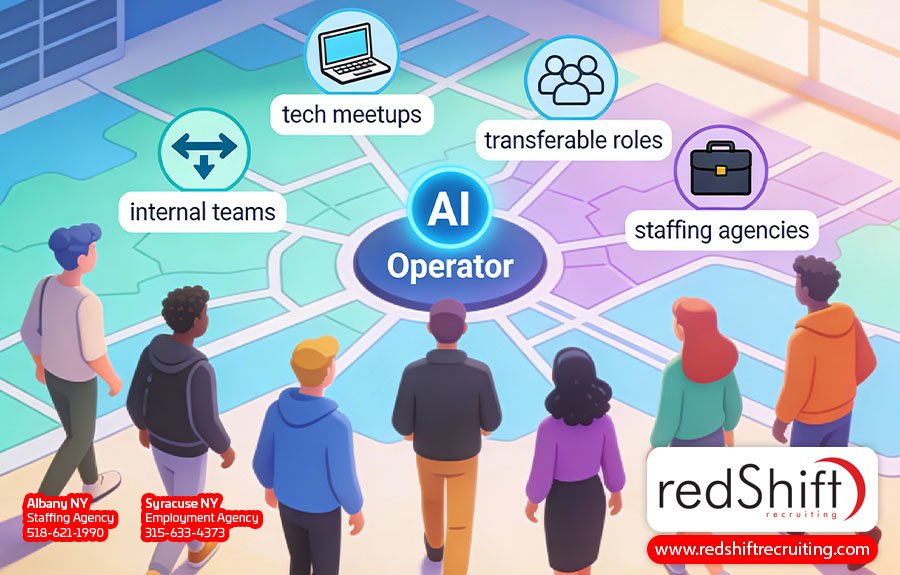
In reality, AI operators are often already inside your organization or working in adjacent roles that sit close to automation, decision-making, and operational workflows. Avoiding an AI talent shortage starts with widening the search beyond formal AI titles.
Internal Talent Pools to Prioritize
Many of the strongest operators come from within. Internal candidates already understand your systems, processes, and risk tolerance, giving them a head start in roles that depend more on context and reasoning than on advanced technical skills. Look for:
System power users who work with dashboards, reporting platforms, or AI-enabled tools
Analysts who interpret data, question assumptions, and translate outputs into decisions
Operations or process specialists who know where automation succeeds, as well as where it breaks down
These individuals often bring the soft skills and applied understanding needed to oversee AI-driven workflows, even if they’ve never worked in AI development, data science, or machine learning.
External Talent Pools Worth Targeting
Some hiring needs require looking beyond your internal team. When you hire AI engineers, data specialists, or operators for more complex environments, prioritize candidates with experience validating systems, managing exceptions, or supporting automated workflows. Strong external pools include:
QA or technical support professionals who investigate failures and edge cases
Workflow or automation specialists who help teams adopt new tools
Operations coordinators with exposure to AI-enabled platforms or conversational AI systems
These candidates often have experience maintaining AI systems, supporting users, or reviewing automated output—even if they’ve never worked for an AI agent development company or another specialized AI vendor.
Focus on Relevant Experience, Not Perfect Titles
Because this is an emerging field, the “right” title rarely exists. Hiring managers who insist on finding the perfect candidate with highly specialized skills often slow down their AI hiring efforts unnecessarily. In this role, learning agility often matters more than familiarity with specific tools.
Rather than prioritizing engineering depth or prior work developing AI agents, look for candidates who:
Ask good questions about outputs and assumptions
Understand how AI fits into real workflows
Collaborate well across teams and expose risks early
Organizations that broaden their search this way are far more likely to build an effective AI team and gain a meaningful competitive advantage from their AI investments. This approach ultimately leads to a stronger final hiring decision that focuses on capability, not titles.
How to Evaluate AI Operator Candidates Effectively
Evaluating AI operators requires a different approach than assessing AI developers or engineers. Traditional interviews tend to focus on technical depth or platform familiarity, but offer less insight into how candidates think—how they interpret AI outputs, respond when something looks off, and act when an automated decision could introduce risk.
Behavioral Interview Focus
Shift behavioral interviews away from tools and toward judgment. Rather than asking which models or platforms a candidate has used, ask questions that reveal how they’ve responded to uncertainty in past roles. Strong prompts include:
Times they questioned or corrected automated outputs
Situations involving unclear data, conflicting signals, or incomplete information
How they balanced speed, accuracy, and risk under pressure
These conversations are far more telling than probing whether a candidate can build or deploy machine learning models. AI operators don’t need the technical know-how of the best AI engineers—but they do need to articulate which decisions they would own, when they would escalate an issue, and how they maintain accountability in complex AI projects.
Scenario-Based Evaluation
Scenario exercises are one of the most effective ways to evaluate operators. Present a flawed or ambiguous AI output and ask the candidate to walk through their reasoning. Useful examples include:
An AI recommendation that conflicts with human judgment
A decision produced by unclear or incomplete data
A confident output from a conversational AI chatbot that lacks explainability
Ask how they would validate the result, who they would involve, and when they would intervene. What matters is not speed—it’s clarity of reasoning. This shows how they would perform once an AI solution is embedded in real workflows with minimal human input.
What to Watch For
A few traits consistently signal a strong AI Operator:
Healthy skepticism, not blind trust in automated outputs
Clear reasoning rather than reliance on jargon or hype
Willingness to ask questions, flag risks, and speak up
Candidates who treat AI systems as unquestionable or focus solely on performance metrics may struggle in this role. In contrast, strong operators understand that effective oversight supports ethical AI development and protects long-term outcomes. Paying attention to these signals strengthens the organization’s ability to hire an AI operator who contributes to a responsible culture and a more reliable AI workflow.
Writing an Effective AI Operator Job Description
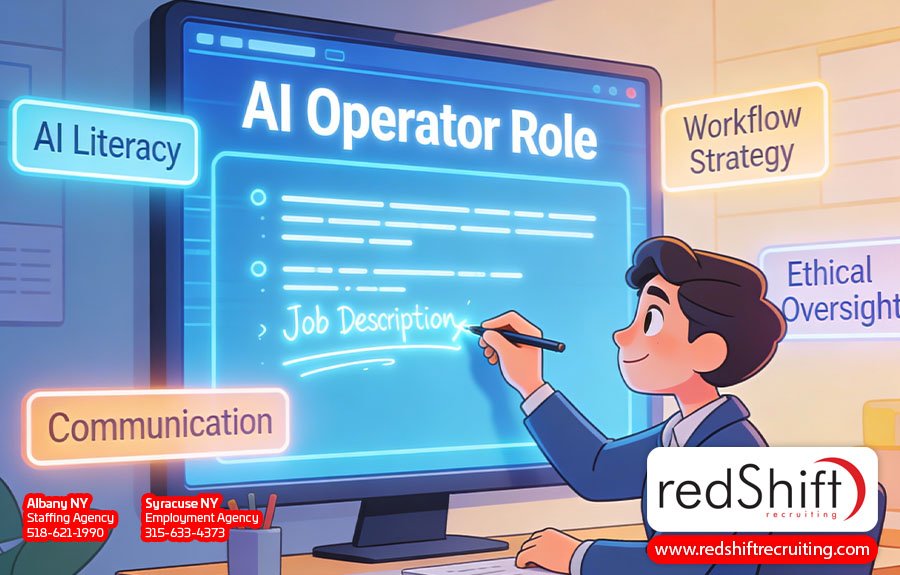
A clear, well-written AI operator job description helps hiring teams attract people with the right mindset while discouraging candidates who belong in engineering or AI agent development roles. Many employers struggle here because they either overstate the technical side of the job or reuse templates meant to hire AI developers or engineers. That approach often backfires on job boards, pulling in candidates with strong hard skills in coding but little interest in oversight, validation, or operational accountability. The goal is to write a description that speaks directly to the work operators actually do.
Use Clear, Human-Centered Language
AI operators don’t exist to advance AI research, build new models, or architect systems. They work with AI already embedded in workflows, monitoring outcomes, questioning outputs, and supporting teams as the organization expands its AI footprint. When crafting job descriptions, focus the language on:
Decision-making and judgment
Oversight of AI-driven outputs
Collaboration across technical and operational teams
This keeps the role grounded in context and reasoning rather than raw technical know-how.
Avoid Developer-Style Framing
Avoid titles or descriptions that imply responsibility for building systems, writing production code, or doing AI development. Phrases associated with engineering roles—like designing architectures, deploying pipelines, or building AI agents—signal that you’re looking for an AI developer, not an operator. This is also where candidates working in engineering roles at a development company or on agent teams may misread the expectations.
Be explicit about what the role does not own, such as:
Building or training models
Implementing new agent architectures
Writing backend or production code
This clarity helps candidates understand the scope and reduces noise from applicants better suited for engineering work.
Emphasize Oversight, Not Ownership
A strong job description highlights responsibility without implying system ownership. Candidates should understand they will oversee technology used in real AI projects, support teams as AI tools or agents are implemented, and validate outcomes that operate with minimal human input. Helpful emphasis areas include:
Reviewing AI outputs and flagging inconsistencies
Escalating risks tied to data handling or automation errors
Working with cross-functional teams on new AI initiatives
This framing makes it clear the role is about supervision and judgment, not development work.
Include Realistic, Day-to-Day Examples
Generic descriptions attract generic candidates. Instead, describe what operators actually do day-to-day—reviewing outputs, documenting exceptions, supporting end users, or coordinating with data scientists or AI engineers when an issue needs escalation. Clear examples also prevent confusion for candidates coming from related AI jobs.
For most companies, this clarity leads to stronger applicants, fewer mismatches, and ultimately a better final hiring decision. As AI adoption grows, many organizations expand this role to include broader quality, governance, or oversight responsibilities, making it ideal for candidates who want to grow their AI expertise, build a strong track record, and contribute to the organization’s long-term success with AI.
Onboarding and Retaining AI Operators
Hiring an AI operator is only the starting point. A structured onboarding process gives them the context they need before taking on autonomy—exposure to real workflows, decision paths, and risk thresholds. This helps operators understand how AI is actually used in day-to-day work and prepares them to intervene or escalate concerns when needed. Pairing new hires with domain experts early on also accelerates learning and prevents avoidable errors.
Success for AI operators shouldn’t be measured by speed alone. More meaningful indicators include accuracy, quality of judgment, and consistent documentation when something doesn’t look right. As organizations rely more heavily on automated outputs, these signals matter far more than task velocity.
Retention improves when AI operators are treated as a distinct career path rather than a stepping stone to roles held by engineers or artificial intelligence developers. Clear growth options may include supporting internal AI agent development, collaborating with technical teams, or contributing to broader oversight across AI-enabled workflows. Strong operators also tend to stay longer when they see how their work delivers value alongside other AI jobs, and how their oversight helps ensure that AI developers' work aligns with safe, responsible implementation. Organizations that recognize the importance of this role build more sustainable AI practices and maintain a healthier, more resilient workforce.
Want to dig deeper into the world of AI agents? 🤖✨
These related articles explain how AI agents work—and how they differ from AI Operators:
Frequently Asked Questions
What Interview Questions Reveal Good Judgment in AI Operator Candidates?
Look for questions that expose how a candidate thinks, not just what tools they’ve used. Ask about a time they challenged an automated output, how they handled conflicting data, or when they escalated an issue that didn’t seem right. Strong candidates can explain their reasoning clearly, including what information they needed, who they involved, and how they balanced speed with risk. If they default to technical answers better suited for an AI developer, that’s often a sign they’re not aligned with an operator’s oversight-focused responsibilities.
When Should a Company Hire an AI Operator Instead of AI Engineers or Developers?
Hire an AI operator when your systems are already built and you need someone to monitor outputs, validate decisions, and step in when automation behaves unpredictably. This role is about judgment, context, and accountability, not creating new models or writing code. An AI developer can build or refine the underlying models and features, while an AI engineer designs, deploys, and maintains the infrastructure that supports them. In contrast, an operator ensures those systems and workflows function safely and responsibly once deployed.
How Do You Test an AI Operator’s Ability to Handle Bad AI Output?
Give candidates a flawed or ambiguous AI output and ask them to walk through how they’d respond. A strong operator should question assumptions, gather context, identify risks, and explain when human review or escalation is necessary. This exercise mirrors what they’ll do in practice and helps you see whether they prioritize safety and clarity over speed. It also shows whether they understand when to involve technical teams or an AI agent development partner if an issue requires deeper investigation.
What Career Paths Exist for AI Operators?
AI operators can grow into roles that influence governance, process quality, or cross-functional oversight as AI adoption expands. Some move into workflow design, compliance, or model monitoring roles. Others collaborate closely with AI engineers, data scientists, or AI governance teams to support more complex operational environments. Unlike engineering career paths, growth here centers on context expertise, risk awareness, and leadership in human-in-the-loop AI operations.
Where Should AI Operators Sit in the Organization?
Most companies place AI operators within operations, data science, or QA teams—groups close to real workflows and decision-making points. The best placement depends on where AI-driven outputs have the greatest business impact. They should sit close enough to technical teams to flag issues quickly, but not so embedded in engineering that they are treated like developers. Their role complements engineering rather than replacing it, which helps clarify when the organization needs oversight from an operator versus development work from a developer.
Conclusion
Hiring AI operators isn’t about finding the most technical candidate—it’s about finding people who can think clearly, question confidently, and keep automated systems aligned with real-world expectations. As AI becomes woven into everyday workflows, these roles provide the oversight and judgment that technology can’t replicate. Organizations that define the role clearly, evaluate candidates thoughtfully, and support operators with strong onboarding and growth opportunities will build AI systems that are safer, more reliable, and far more effective over time. Ultimately, investing in skilled AI operators strengthens your workflows, protects your teams, and ensures your AI strategy delivers lasting value.

Article Author:
Ashley Meyer
Digital Marketing Strategist
Albany, NY